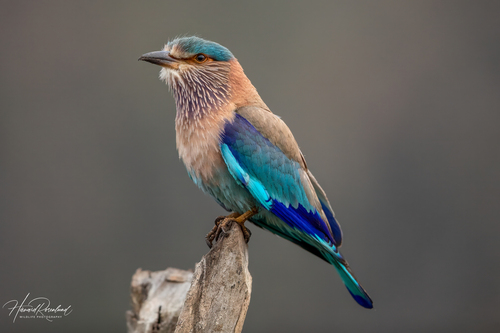
Indian Roller
Coracias benghalensis
A flash of brilliant turquoise against the dusty landscape, the Indian Roller is an icon of the South Asian countryside. Known for its acrobatic displays and stunning blue wings, this bird is a favorite for backyard observers and photographers alike.
Quick Identification
Size
Length: 30–34 cm (12–13 in); Wingspan: 65–74 cm (26–29 in); Weight: 166–176 g (5.9–6.2 oz)
Colors
Brownish-cinnamon head and back with a pinkish-lilac throat; brilliant turquoise and dark indigo blue bands on the wings and tail, most visible in flight; turquoise rump.
Key Features
- Brilliant bands of light and dark blue on the wings
- Pinkish-lilac throat and face
- Strong, hooked black bill
- Stocky build often seen perched on wires
- Turquoise tail with dark blue central feathers
When You’ll See Them
Geographic range
Where Does the Indian Roller Live?
The Indian Roller is native to the Asian continent, where it serves as a vibrant fixture of the landscape. Its core range spans across the Indian Subcontinent, including India, Pakistan, Bangladesh, and Sri Lanka, extending eastward into Myanmar. While it is predominantly a resident species within these regions, its presence is most heavily concentrated in the lowland plains and plateau regions where open hunting grounds are plentiful. Because of its adaptability, it is frequently seen in human-dominated environments like roadside verges and farmstead perimeters.
Basemap © OpenStreetMap contributors
Behavior
The Indian Roller is a quintessential "sit-and-wait" predator. It spends a significant portion of its day perched conspicuously on roadside wires, fence posts, or bare tree branches, scanning the ground for movement. When it spots prey, it drops down with a sudden, swift pounce to snatch its meal before returning to its vantage point. Despite its somewhat drab appearance when perched, it transforms into a flash of brilliant azure when it takes flight.
During the breeding season, these birds earn their name through spectacular aerial displays. Males perform a series of steep climbs followed by nose-dives, twisting and "rolling" their bodies while emitting harsh, raucous calls to attract mates. They are generally solitary or found in pairs, maintaining a watchful eye over their territory and showing little fear of human activity in rural and suburban settings.
EverydayEarth exclusive
Camera Tips
To capture the Indian Roller, position your camera near elevated, exposed perches. These birds are creatures of habit and will return to the same telephone wire, fence post, or dead branch day after day. If you have a backyard garden, installing a T-shaped wooden perch (about 6-8 feet high) in an open area can provide an irresistible hunting station for them. Angle your camera slightly upward to catch the bird against the sky, or level with the perch to capture detailed portraits of their lilac throat and heavy bills.
Because the Indian Roller's most striking feature is its blue wing pattern, look for settings that allow for high-speed triggering. A trail camera with a fast trigger speed (0.2s or less) is essential if you want to capture the moment they launch into flight. Set your camera to burst mode or "Photo + Video" to ensure you catch the transition from the relatively camouflaged perched position to the explosion of blue as they take off.
While they don't visit traditional seed feeders, they are highly attracted to areas with high insect activity. If you use a camera near a compost pile or a recently mowed lawn, you are more likely to see them pouncing for disturbed crickets or beetles. For the best lighting, aim your camera to face away from the sun (North or South) to avoid washing out those deep turquoise hues in the morning or late afternoon light.
Similar Species
Species that look similar or are commonly confused with Indian Roller.
Indochinese Roller
Darker, purplish-blue plumage and lacks the pale pinkish-lilac throat of the Indian Roller.
European Roller
Features a much paler, uniform turquoise head and underparts without the brown cinnamon back.
Lilac-breasted Roller
Found in Africa; has a much deeper purple breast and long tail streamers.
Frequently Asked Questions
Record Indian Roller at your habitat
Connect a camera to start building your own species record — AI identifies every visitor automatically.