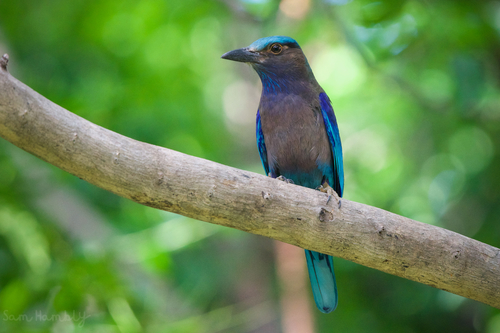
Indochinese Roller
Coracias affinis
A flash of electric blue in the tropical sun, the Indochinese Roller is a master of the air and a staple of Southeast Asian landscapes. Known for its daring aerial acrobatics and 'sit-and-wait' hunting style, it is one of the most rewarding birds to spot in a backyard or garden.
Quick Identification
Size
30–34 cm (12–13.5 in) in length; wingspan of 65–75 cm (25–30 in); weight ranges from 160–190 g (5.6–6.7 oz)
Colors
Deep purplish-brown breast and mantle; brilliant turquoise-blue crown; striking bands of dark and electric blue on wings and tail; black bill
Key Features
- Large head with a stout black bill
- Purplish-brown throat lacking white streaks
- Electric blue wing patches highly visible in flight
- Square-ended tail with a broad turquoise terminal band
When You’ll See Them
Geographic range
Where Does the Indochinese Roller Live?
Native to the lush landscapes of Southeast Asia and the eastern Himalayas, the Indochinese Roller is a jewel of the Indomalayan realm. Its range spans from eastern Nepal and Northeast India across the diverse terrains of Myanmar, Thailand, Laos, Cambodia, and Vietnam, reaching into the southern tip of China and the northern Malay Peninsula. These birds are a frequent sight in both wild tropical forests and the rural outskirts of bustling cities, thriving wherever open ground meets high perching spots.
Basemap © OpenStreetMap contributors
Behavior
Indochinese Rollers are the acrobats of the bird world, famous for their spectacular territorial displays where they perform steep dives, loops, and 'rolls' while emitting harsh, grating calls. They are classic sit-and-wait predators, often seen perched motionless on telephone wires, fence posts, or bare branches, scanning the ground for the slightest movement. Despite their flashy colors, they can remain remarkably still until they suddenly drop like a stone to snatch up prey.
While generally solitary or seen in pairs during the breeding season, they are surprisingly tolerant of human activity. They often exploit human-altered landscapes, such as agricultural fields and garden edges, where the short grass or cleared ground makes it easier to spot insects. They are highly territorial over their favorite perching spots and will aggressively chase away larger birds, including crows and raptors, from their hunting grounds.
EverydayEarth exclusive
Camera Tips
To capture the Indochinese Roller on your backyard camera, placement is everything. These birds are 'perch hunters,' so look for solitary, exposed branches or fence posts overlooking an open patch of lawn or garden. Mount your camera 5 to 8 feet off the ground, angled slightly upward toward a favorite branch, or level with a known perching spot. Because they drop to the ground to hunt, a second camera positioned 1-2 feet off the ground facing a clear patch of earth can catch the dramatic moment of a strike when they dive for an insect.
AI-powered cameras should be set to high sensitivity for motion, as their 'drop' from a perch is lightning-fast. Since they are most active in the golden hours of early morning and late afternoon, ensure your camera has a wide dynamic range to handle the backlighting of a rising or setting sun. If you are trying to attract them to a specific backyard spot, maintaining a patch of shortly mown grass or a 'dust bath' area can be more effective than birdseed, as they are looking for movement and protein rather than grains.
During the breeding season from March to June, they often search for hollowed-out tree trunks or holes in old buildings for nesting. If you identify a potential nest site, place your camera at a respectful distance of at least 15-20 feet. High-speed shutter settings or a 'burst mode' are essential to freeze their brilliant blue wings in flight; otherwise, their rapid wingbeats will appear as a mere blur of turquoise. Avoid using high-intensity white flashes at night to prevent disturbing their roosting patterns.
Similar Species
Species that look similar or are commonly confused with Indochinese Roller.
Frequently Asked Questions
Record Indochinese Roller at your habitat
Connect a camera to start building your own species record — AI identifies every visitor automatically.