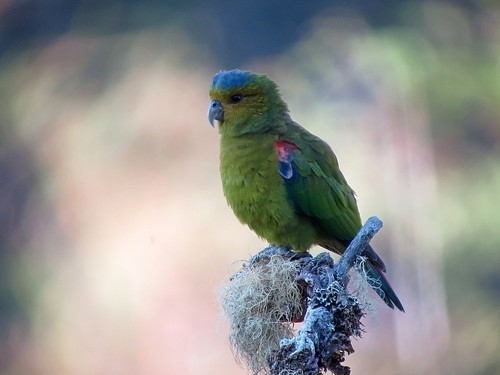
Indigo-winged Parrot
Hapalopsittaca fuertesi
A rare emerald of the Colombian Andes, the Indigo-winged Parrot was once thought extinct until its dramatic rediscovery in 2002. This vibrant bird is a symbol of cloud forest conservation, identifiable by the stunning flash of indigo on its wings.
Quick Identification
Size
23-24 cm (9-9.5 inches) in length; approximately 115-130 grams (4-4.6 oz)
Colors
Mainly green body with a yellow-green face and crown; distinctive indigo-blue flight feathers and primary coverts; red patches on the shoulders (lesser coverts); red-brown tail with a blue tip.
Key Features
- Indigo-blue wing patches
- Yellowish face and crown contrasting with green body
- Small, stocky parrot silhouette
- Red 'shoulder' patches visible in flight
When You’ll See Them
Geographic range
Where Does the Indigo-winged Parrot Live?
Native to the South American continent, the Indigo-winged Parrot is a micro-endemic species found only in a tiny portion of the Central Andes of Colombia. Its core range is restricted to the western slopes of the Central Cordillera, specifically within the departments of Quindío, Risaralda, and Tolima. This critically restricted range makes it one of the rarest birds in the world, surviving in high-altitude forest fragments.
Basemap © OpenStreetMap contributors
Behavior
The Indigo-winged Parrot is a social yet elusive bird, typically seen in small, noisy groups of 3 to 15 individuals. They are most active during the early morning and late afternoon as they commute between roosting sites and feeding grounds high in the Andean canopy. Their flight is fast and direct, often accompanied by sharp, screeching calls that reveal their presence even when they are hidden by the dense mist of the cloud forest.
While they are generally shy around humans, these parrots are highly dedicated to their social groups, often engaging in mutual preening and synchronized feeding. They are specialized foragers, rarely descending to the ground, preferring to stay within the safety of the mid-to-upper canopy where they can find their preferred food sources. Their breeding season typically occurs between January and May, coinciding with the peak fruiting of their favorite trees.
EverydayEarth exclusive
Camera Tips
Capturing the Indigo-winged Parrot on camera requires high-altitude placement, as these birds rarely descend below the canopy. To increase your chances, position cameras on ridges or steep slopes where the tree canopy is level with the ground or reachable via climbing. Focus your setup on known feeding trees, particularly Andean Oaks or trees heavily laden with mistletoe (Antidaphne viscoidea), which is their primary food source.
Because the cloud forest environment is notoriously damp and misty, use high-quality weatherproofing or an external housing to prevent lens fogging and moisture damage. Set your camera to a high shutter speed or 'Action' mode to catch their rapid flight movements, and use burst mode to capture the subtle flash of indigo on their wings. Since the lighting under the canopy can be dim, a camera with a high-performance low-light sensor is essential.
Baiting with artificial feeders is generally unsuccessful for this specialist species. Instead, look for 'lure' sites like natural mineral licks or specific flowering epiphytes that they frequent. Aim your camera horizontally across gaps in the canopy where the parrots are known to fly through. Early morning light provides the best contrast for their green and blue plumage, so ensure your camera's wake-up sensor is sensitive enough to trigger as the sun rises over the Andean ridges.
Similar Species
Species that look similar or are commonly confused with Indigo-winged Parrot.
Frequently Asked Questions
Record Indigo-winged Parrot at your habitat
Connect a camera to start building your own species record — AI identifies every visitor automatically.