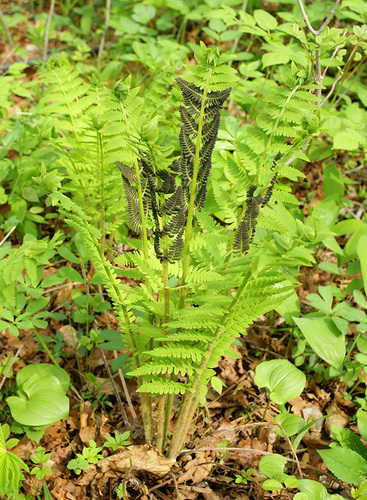
interrupted fern
Osmunda claytoniana
The interrupted fern is a living fossil for your backyard, famous for the unique gap in its fronds where spores are produced. Its architectural elegance and vibrant green stalks make it a stunning focal point for any shaded trail camera setup.
Quick Identification
Size
2 to 4 feet tall (60–120 cm) with a spread of 2 to 3 feet (60–90 cm)
Colors
Bright green sterile fronds; dark brown or charcoal-colored fertile leaflets that appear mid-stalk
Key Features
- Fronds grow in a vase-like circular cluster
- Center of the frond is 'interrupted' by small, dark fertile leaflets
- Bipinnate fronds with rounded, deeply lobed segments
- Fiddleheads are covered in white, woolly hair in early spring
When You’ll See Them
Behavior
The interrupted fern is a slow-growing, long-lived perennial that brings a sense of prehistoric wonder to the backyard. Unlike most ferns that carry their spores on the underside of their leaves or on separate stalks, this species grows fertile leaflets right in the middle of a green frond. These dark, shriveled-looking leaflets drop off by mid-summer, leaving a literal gap or 'interruption' in the foliage that makes the plant instantly recognizable.
In the wild, these ferns function as vital structural components of the forest floor. They provide essential cover for ground-nesting birds, amphibians, and small mammals like chipmunks. While they don't 'interact' with humans in a social sense, they are exceptionally hardy and resistant to deer and rabbits, making them a favorite for naturalistic shade gardens. Their presence usually indicates a healthy, moist ecosystem with rich soil.
EverydayEarth exclusive
Camera Tips
To capture the true magic of the interrupted fern, set your camera to a time-lapse mode during the early spring (usually late April to early May). Positioning the camera at a low 'worm's-eye' view allows you to document the dramatic unfurling of the woolly fiddleheads. Aim for one frame every 30 minutes to create a smooth video of the fronds reaching toward the canopy.
Lighting is your best friend when photographing this species. Because the fronds are somewhat translucent, placing your camera so it faces the morning or late afternoon sun will result in 'backlighting.' This makes the green leaflets glow and highlights the dark, textured contrast of the interrupted fertile segments in the middle of the stem. A side-angle shot is better than a top-down view to show the architectural 'vase' shape of the entire plant.
If you are using a motion-activated trail camera to catch wildlife, the interrupted fern makes an excellent 'stage.' Place your camera 12-18 inches off the ground, facing a cluster of these ferns. Small mammals and ground birds often use the dense base of the fern for cover. However, be mindful of the wind; fern fronds are highly sensitive to breezes and can trigger hundreds of 'false' photos. Set your camera's sensitivity to 'medium' or 'low' and ensure no loose fronds are directly in front of the sensor.
Don't stop recording once summer hits. In the autumn, these ferns turn a brilliant, buttery yellow. This color shift provides a high-contrast background for any backyard visitors like squirrels or foxes. For the best color accuracy, ensure your white balance is set to 'Auto' or 'Daylight' to avoid the camera washing out the golden hues against the dark forest floor.
Similar Species
Species that look similar or are commonly confused with interrupted fern.
Frequently Asked Questions
Record interrupted fern at your habitat
Connect a camera to start building your own species record — AI identifies every visitor automatically.