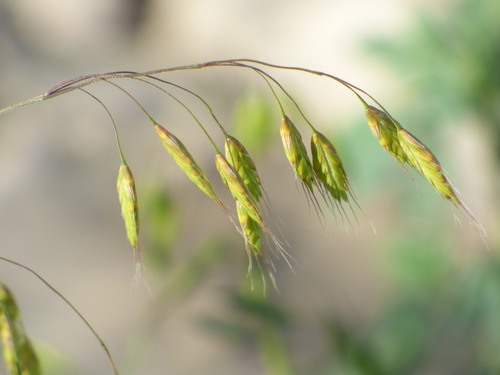
Japanese brome
Bromus japonicus
A graceful annual grass known for its drooping, nodding seed heads, Japanese brome is a master of suburban survival. Though often considered a weed, it provides vital cover for small backyard creatures during the spring transition.
Quick Identification
Size
12–24 inches (30–60 cm) in height; panicles 3–8 inches (7–20 cm) long
Colors
Pale green during growth, maturing to a light tan or straw color; seed awns occasionally show a purple tint
Key Features
- Nodding or drooping pyramid-shaped seed clusters
- Soft, fine hairs covering the leaf sheaths and blades
- Awns (bristles) that are 1/4 to 1/2 inch long and slightly twisted
- Hollow, slender stems with swollen nodes
When You’ll See Them
Behavior
Japanese brome is a winter annual grass that follows a rapid lifecycle designed for survival in disturbed soils. It typically germinates in the autumn or early spring, establishing a low-profile rosette before shooting upward as temperatures rise. Unlike perennial grasses that invest energy in deep root systems, this species focuses entirely on seed production, often creating dense stands that outcompete native vegetation by soaking up early-season moisture.
As the plant matures, its heavy seed heads begin to droop gracefully, a characteristic 'nodding' habit that helps distinguish it from more upright brome species. By mid-summer, the plant has usually completed its lifecycle, turning a parched golden color and dropping its seeds to the earth. These seeds are often transported by the wind or by hitching a ride on the fur of passing backyard mammals, ensuring the next generation is spread throughout the neighborhood.
EverydayEarth exclusive
Camera Tips
Capturing Japanese brome on a backyard camera requires a different strategy than tracking moving wildlife. Because this grass is highly susceptible to wind, standard motion-trigger settings often result in thousands of 'false' triggers. To truly document its beauty and growth, switch your camera to 'Time-Lapse' mode. Set the interval to one photo every 60 minutes during daylight hours to capture the fascinating 'bolting' phase where the grass shoots up several inches in a single week during late spring.
For the best aesthetic results, position your camera at a 'worm's eye view'—about 4 to 6 inches off the ground. Angle the lens slightly upward to capture the drooping seed heads against the sky. This perspective makes the grass look like a towering forest, which provides excellent context if you happen to catch a beetle or a small rodent scurrying through the stems. If your camera has a macro or close-focus setting, use it; the fine hairs on the leaves of Japanese brome catch morning dew beautifully, creating high-contrast images.
Keep seasonal lighting in mind. In the late afternoon (the 'golden hour'), the sunlight will catch the translucent husks of the seeds, making the entire plant appear to glow. This is the ideal time to check for insect activity, as many pollinators will rest on the swaying stalks. Ensure the area immediately in front of the lens is clear of stray blades of grass that might cause the infrared flash to overexpose the image at night, which can happen if the grass leans too close to the sensor on a windy evening.
Similar Species
Species that look similar or are commonly confused with Japanese brome.
Cheatgrass
Cheatgrass turns a distinct rusty red-purple color when mature and has longer, straighter awns.
Rye Brome
Rye brome has thicker, heavier seeds and the leaf sheaths are usually hairless compared to the fuzzy Japanese brome.
Smooth Brome
Smooth brome is a perennial with an upright growth habit and lacks the long bristles (awns) on the seeds.
Frequently Asked Questions
Record Japanese brome at your habitat
Connect a camera to start building your own species record — AI identifies every visitor automatically.