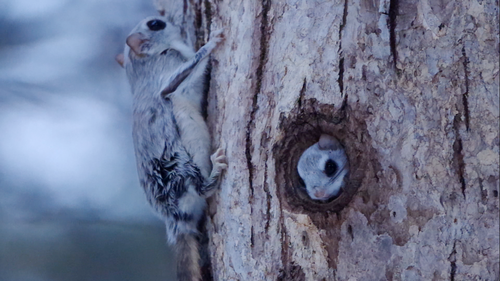
Japanese Flying Squirrel
Pteromys momonga
The Japanese Flying Squirrel is a nocturnal wonder of the Japanese woods. With its massive eyes and soft, velvet-like fur, this master of the night canopy glides through the forest like a silent, living kite.
Quick Identification
Size
Body length 14–20 cm (5.5–8 in), tail 10–14 cm (4–5.5 in), weighing 150–220 g (5–8 oz)
Colors
Soft silvery-gray to buff-brown upperparts; creamy white underbelly; large, dark liquid-black eyes
Key Features
- Enormous soul-piercing black eyes
- Fur-covered gliding membrane (patagium) between limbs
- Small, rounded ears and a flattened, bushy tail
- Compact, orb-like body shape
When You’ll See Them
Geographic range
Where Does the Japanese Flying Squirrel Live?
This enchanting glider is a Japanese endemic, found nowhere else on Earth in the wild. It makes its home across the major islands of the Japanese archipelago, specifically Honshu, Shikoku, and Kyushu. Within this range, it thrives in montane forests and subalpine regions where old-growth trees provide the necessary hollows for nesting and protection from predators.
Basemap © OpenStreetMap contributors
Behavior
The Japanese Flying Squirrel is a strictly nocturnal mammal that spends the vast majority of its life high in the forest canopy. Unlike many other squirrels, it rarely descends to the forest floor, preferring to move between trees by gliding. By extending its limbs, it stretches out its specialized skin membrane to create a sail-like surface, allowing it to glide gracefully for distances exceeding 100 meters. They use their flat tails as rudders to steer through the dense branches with remarkable precision.
Socially, these squirrels are remarkably peaceful and communal. During the cold winter months, it is common to find several individuals—sometimes of the same sex—huddled together in a single tree hollow or nesting box to conserve body heat. While they are shy and retreat quickly from loud noises, they are not particularly fearful of humans if approached quietly, making them a favorite subject for patient nighttime observers.
EverydayEarth exclusive
Camera Tips
To successfully capture a Japanese Flying Squirrel on camera, you must think vertically. These animals spend very little time on the ground, so mounting your camera at eye level won't work. Instead, secure your camera 2 to 5 meters up the trunk of a mature conifer or maple tree. Use a tree-climbing strap and angle the lens slightly downward to cover the area where a squirrel might land or emerge from a nesting hole. If you can identify a 'latrine tree'—recognizable by the small, grain-like droppings at the base—you have found a high-traffic area.
Because they are strictly nocturnal, your camera’s infrared (IR) performance is critical. Opt for 'No-Glow' or 'Black IR' LEDs; standard red-glow IR can occasionally startle these sensitive creatures. Set your camera to take short video clips (10–20 seconds) rather than just still photos. A still image often results in a blurry gray streak as they glide past, but a high-frame-rate video will capture the incredible 'parachute' effect of their gliding membrane and their soft landing on the bark.
Backyard enthusiasts can attract them by installing specialized nesting boxes high in trees, which often become the focus of their activity. Since they are most active in the dark, ensure your camera has a fast trigger speed (under 0.3 seconds). They move with surprising speed once they land, scurrying to the opposite side of the tree trunk to hide from potential owls. Positioning two cameras on opposite sides of a prominent trunk is an advanced trick used by pros to ensure they don't miss the action.
Similar Species
Species that look similar or are commonly confused with Japanese Flying Squirrel.
Frequently Asked Questions
Record Japanese Flying Squirrel at your habitat
Connect a camera to start building your own species record — AI identifies every visitor automatically.