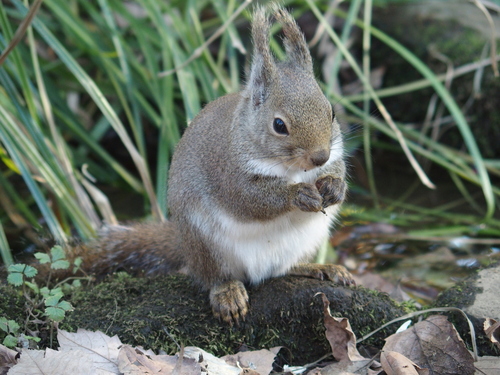
Japanese Squirrel
Sciurus lis
The Japanese Squirrel is a charismatic acrobat of the eastern forests, instantly recognizable by its bushy tail and snowy-white belly. An essential forest planter, this industrious squirrel is a delight for backyard observers across the Japanese islands.
Quick Identification
Size
Head-body length of 16–22 cm (6–9 in) with a 13–17 cm (5–7 in) tail; weight ranges from 250–310 g (9–11 oz).
Colors
Brownish-grey to orange-brown upperparts; distinctive pure white underbelly; white rings around eyes; winter coat features long ear tufts.
Key Features
- Bushy tail almost as long as the body
- Pure white belly contrasting with dark back
- Prominent ear tufts visible during winter months
- Distinctive white eye-rings
When You’ll See Them
Geographic range
Where Does the Japanese Squirrel Live?
This charming rodent is a true island specialist, native only to the Japanese archipelago. Its core range includes the islands of Honshu, Shikoku, and Kyushu, where it occupies a variety of elevations from coastal lowlands to subalpine forests. While widely distributed across these three main islands, it is absent from Hokkaido, where it is replaced by the related Eurasian red squirrel.
Basemap © OpenStreetMap contributors
Behavior
The Japanese Squirrel is a diurnal and highly arboreal mammal, spending the vast majority of its life navigating the forest canopy with remarkable speed and precision. They are active year-round and do not hibernate, though they may stay in their nests (called dreys) during particularly harsh winter storms. They are primarily solitary, though they may tolerate the presence of others in areas with abundant food sources like walnut groves.
One of their most notable behaviors is scatter-hoarding. Throughout the autumn, these squirrels work tirelessly to bury seeds and nuts across the forest floor. Because they rely on their memory rather than scent to relocate these caches, many seeds are left undisturbed, making this species an essential gardener for Japan's forests. In suburban settings, they can become quite accustomed to human activity, often using fences and power lines as aerial highways to navigate between gardens.
EverydayEarth exclusive
Camera Tips
To successfully capture the Japanese Squirrel on camera, placement is everything. These squirrels are 'edge' specialists, often traveling along the boundaries of forests or garden fences. Position your camera on a tree trunk about 1.5 meters off the ground, angled slightly downward toward a known feeding spot or a horizontal branch that serves as a natural walkway. Because they are incredibly fast, set your camera to its highest trigger speed and use a multi-shot burst mode to ensure you catch the action before they leap out of frame.
Baiting can be highly effective for bringing them into close range. A small pile of walnuts (in the shell) or sunflower seeds placed on a flat stump will usually grab their attention. If you want to capture their famous 'caching' behavior, place your camera near a patch of soft, mossy ground during the autumn months when they are most active in burying their winter food supply. Avoid placing cameras in areas with heavy wind-blown foliage, as their rapid movements combined with moving leaves can lead to many empty 'false trigger' recordings.
For the best photographic results, try to capture them during the early morning hours just after sunrise. The low light brings out the reddish hues in their fur and provides a soft glow to their white underbelly. If you are monitoring them in the winter, look for cameras that handle high-contrast scenes well, as the squirrels' dark fur against white snow can sometimes cause exposure issues for lower-end sensors.
Similar Species
Species that look similar or are commonly confused with Japanese Squirrel.
Frequently Asked Questions
Record Japanese Squirrel at your habitat
Connect a camera to start building your own species record — AI identifies every visitor automatically.