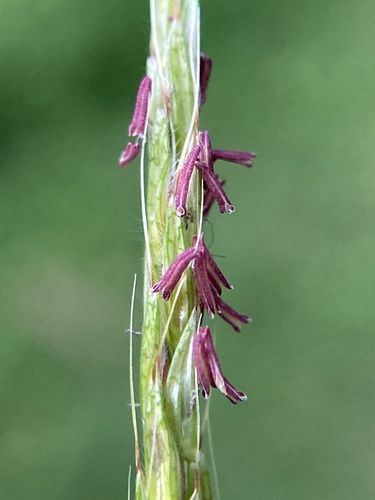
Japanese stiltgrass
Microstegium vimineum
A delicate-looking but tenacious invader, Japanese stiltgrass is famous for its shimmering, silver-striped leaves and its ability to carpet forest floors in deep shade. Though an annual, its incredible seed production makes it a permanent fixture in many North American backyards.
Quick Identification
Size
Height: 30–100 cm (1–3 ft); Leaves: 3–10 cm (1.2–4 in) long and 1.3 cm (0.5 in) wide
Colors
Pale green to lime green foliage; leaves feature a distinctive silvery, off-center midrib that reflects light
Key Features
- Distinctive silvery, reflective midrib along the leaf surface
- Lance-shaped, asymmetrical leaves
- Sprawling, mat-forming growth habit
- Thin, 'stilt-like' stems that root at the nodes
- Delicate flower spikes appearing in late summer
When You’ll See Them
Behavior
Japanese stiltgrass is an aggressive, annual grass that behaves like a colonizer. Unlike many native grasses, it is exceptionally well-adapted to low-light environments, allowing it to carpet forest floors where other plants struggle. It spreads primarily through a massive production of seeds—up to 1,000 per plant—which can remain viable in the soil for up to five years. These seeds are easily transported by water, foot traffic, and foraging wildlife like white-tailed deer, who tend to avoid eating the stiltgrass itself, giving it a competitive advantage over the native plants they do consume.
As it grows, the plant exhibits a 'scrambling' behavior, using its weak, reclining stems to crawl over other vegetation. Where the nodes of the stem touch the ground, they sprout new roots (the 'stilts'), allowing a single plant to quickly claim territory. By late summer, it forms dense, monolithic mats that can physically choke out native wildflowers and tree seedlings, significantly altering the biodiversity of suburban backyards and local woodlands.
EverydayEarth exclusive
Camera Tips
When documenting Japanese stiltgrass with your EverydayEarth camera, focus on capturing the reflective quality of the leaves. Position your camera at a low angle, roughly 6 to 12 inches off the ground, to highlight the 'stilt' roots and the sprawling growth pattern. Using a camera with a macro lens or a close-focus setting is ideal for revealing the most iconic identification mark: the silvery, off-center midrib. This stripe is actually made of reflective hairs that shimmer when the light hits them at the right angle, making it an excellent subject for early morning or late afternoon shots when the sun is low.
To truly capture its invasive nature, we recommend setting up a time-lapse over the course of the summer months. Start your recording in May when the first lime-green sprouts appear; they often look like tiny green boats. By August, you can record the rapid 'matting' effect as the stems elongate and root. This provides invaluable data for managing your backyard ecosystem. If your camera has an AI-trigger, set it to focus on movement in the lower third of the frame to capture how the grass reacts to wind or how seeds might be brushed off by passing animals.
Lighting is your best friend with this species. Because it thrives in shade, standard daylight photos can sometimes look washed out. Try to capture it during the 'golden hour'—the hour after sunrise or before sunset. The low-angled light will catch the silvery midrib and the delicate seed heads (racemes) that appear in late summer. If you are using a trail camera to monitor how wildlife interacts with the grass, look for 'deer trails' that lead through the stiltgrass; the AI can help document how deer selectively graze around it, further encouraging its spread.
Finally, consider the seasonal transition. In October and November, Japanese stiltgrass turns a unique pale tan or slightly orange-purple hue before dying back for the winter. Documenting this color shift is critical for distinguishing it from perennial native grasses that may stay green longer. Adjust your camera's white balance to 'Cloudy' during this time to capture the warm, autumnal tones of the drying stalks, which often remain standing as a 'thatch' through the first few snows.
Similar Species
Species that look similar or are commonly confused with Japanese stiltgrass.
Frequently Asked Questions
Record Japanese stiltgrass at your habitat
Connect a camera to start building your own species record — AI identifies every visitor automatically.