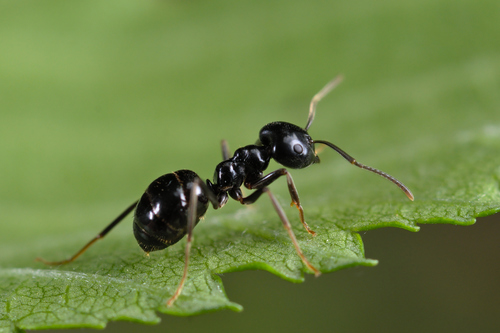
Jet Ant
Lasius fuliginosus
The Jet Ant is the master architect of the woodland world, building reinforced fungal fortresses inside ancient trees. With their polished black armor and citrus-scented trails, they are among the most sophisticated and visually striking ants in the temperate world.
Quick Identification
Size
Workers are typically 4-6 mm (0.16-0.24 inches); Queens are slightly larger at 6-9 mm (0.24-0.35 inches).
Colors
Uniformly high-gloss, polished jet black with a brilliant reflective sheen across the entire body.
Key Features
- Extraordinarily glossy jet-black body
- Distinctly heart-shaped head with a deep indentation at the rear
- Strong aromatic citrus or citronella-like scent when handled
- Moves in very dense, disciplined columns on tree trunks
When You’ll See Them
Geographic range
Where Does the Jet Ant Live?
The Jet Ant is native to the temperate Palearctic region, covering a vast area from Europe through to East Asia. Its core populations are found throughout the United Kingdom, Central Europe, and Scandinavia, extending eastward through Russia, Japan, and parts of China. They thrive in regions with established deciduous woodlands where older trees provide the necessary hollows for their specialized nests.
Basemap © OpenStreetMap contributors
Behavior
Jet Ants are renowned for their remarkable 'carton nests,' which they construct inside the cavities of old, hollow trees. These nests are made from a mixture of chewed wood and saliva, which then becomes host to a specific fungus, Cladosporium myrmecophilum. The ants actively cultivate this fungus, as its mycelium acts like a structural reinforcement—much like rebar in concrete—to strengthen the walls of their colony. This is a rare example of a mutualistic relationship between an ant and a fungus for architectural purposes.
These ants are highly social and follow extremely well-defined pheromone trails that can persist for years. They are often seen in massive, busy columns traveling between their nest and their foraging grounds. They are also known for their 'hyper-parasitic' colony-founding strategy: a new Jet Ant queen cannot start a nest on her own. Instead, she must infiltrate a colony of a different ant species, Lasius umbratus (which itself is a parasite of Lasius niger), kill the resident queen, and use the existing workers to raise her own first brood.
EverydayEarth exclusive
Camera Tips
To capture high-quality footage of Jet Ants, you need to locate their 'ant highways.' Look for mature trees with rough bark and follow the vertical lines of glossy black movement. These ants are creatures of habit and will use the same trails for months or even years. Mount your camera using a flexible tripod or a tree strap, positioning the lens as close to the bark as your camera's minimum focus distance allows. Because Jet Ants are small and move quickly, use a macro lens or a 'macro' setting if your camera has one.
Lighting is the most critical factor for this species. Their high-gloss bodies reflect light beautifully, but they can easily appear as simple black blobs in poor light. Position your camera so that the sun hits the tree trunk at an angle; this will create highlights on their carapaces, revealing their texture and shine. If you are using a trail camera with a flash, be aware that the reflection off their bodies might cause overexposure, so a side-lit natural light setup is often better.
To get the best action shots, use a 'sugar lure.' Smear a small amount of honey or jam on the bark directly in the camera's field of view. This will cause the ants to stop their rapid marching and congregate in a dense group, allowing your camera's AI to lock focus more easily. If your camera supports high frame rates, use them; Jet Ants' antennae move incredibly fast, and capturing that motion clearly requires a fast shutter speed or high-FPS video.
Similar Species
Species that look similar or are commonly confused with Jet Ant.
Frequently Asked Questions
Record Jet Ant at your habitat
Connect a camera to start building your own species record — AI identifies every visitor automatically.