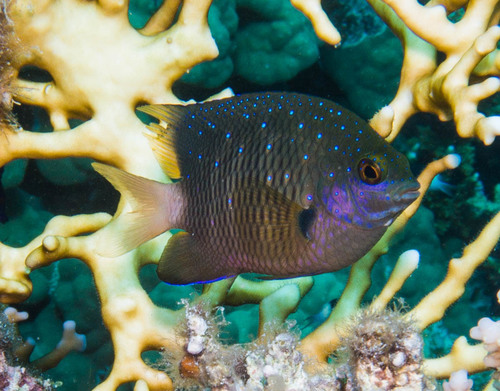
Jewel Damsel
Stegastes lacrymatus
A glittering gem of the reef, the Jewel Damsel is a tiny but feisty farmer that guards its underwater garden with shimmering intensity.
Quick Identification
Size
Up to 10 cm (3.9 inches) in length
Colors
Deep chocolate brown to charcoal body; peppered with numerous small, iridescent neon-blue or white spots that resemble stars or jewels.
Key Features
- Dark brown base color with iridescent blue spotting
- Distinctive rounded tail and dorsal fins
- Aggressive, territorial posturing
- Small, terminal mouth used for grazing
When You’ll See Them
Geographic range
Where Does the Jewel Damsel Live?
The Jewel Damsel is a signature resident of the vast Indo-Pacific region, flourishing in warm tropical waters. Its native range stretches from the shores of East Africa and the Red Sea across to the Line Islands and the Tuamotu Archipelago. Within this massive expanse, they are commonly found along the Great Barrier Reef in Australia, the coastal waters of Indonesia and the Philippines, and as far north as southern Japan. While they are strictly an Indo-Pacific species, they are a common sight for snorkelers and reef-watchers throughout the central and western Pacific islands.
Basemap © OpenStreetMap contributors
Behavior
The Jewel Damsel is a fascinating 'farmer' of the reef. Unlike many wandering fish, this species is highly sedentary and fiercely territorial, claiming a small patch of coral or rock as its own 'algae garden.' They actively weed out unpalatable algae to encourage the growth of their preferred food sources, defending these plots against much larger intruders, including human divers, with surprising bravado.
Socially, they are often solitary as adults due to their territorial nature. Their lives revolve around the maintenance of their territory, which serves as both a larder and a nesting site. During the breeding season, males become even more protective, performing courtship displays to attract females to lay eggs within their guarded domain, which the male then aerates and protects until they hatch.
EverydayEarth exclusive
Camera Tips
Capturing the Jewel Damsel requires an underwater housing or a specialized waterproof action camera. Because these fish are extremely territorial, the best strategy is to locate a 'garden'—a patch of reef that looks noticeably greener or more 'manicured' than the surrounding area. Once you identify a territory being defended by a Jewel Damsel, place your camera on a weighted tripod or secure it to a nearby rock (taking care not to damage live coral) about 30 to 50 centimeters from the fish's favorite perch.
Since these fish are most active during the day, capitalize on the midday sun when light penetration is at its peak. This will help capture the iridescent 'jewels' on their scales, which can look dull in low light. If you are filming in water deeper than 5 meters, consider using a red filter or a portable underwater video light to restore the vibrant brown and blue tones that are often lost to the blue-green cast of the ocean.
Set your camera to a high frame rate (60fps or higher) if possible. Jewel Damsels move in quick, jerky bursts when defending their territory or grazing. A higher frame rate allows you to slow down the footage in post-production, revealing the intricate details of their fin movements and social interactions. Because they are curious and bold, they will likely approach the camera lens to inspect it or even 'attack' it, providing excellent close-up opportunities.
Similar Species
Species that look similar or are commonly confused with Jewel Damsel.
Frequently Asked Questions
Record Jewel Damsel at your habitat
Connect a camera to start building your own species record — AI identifies every visitor automatically.