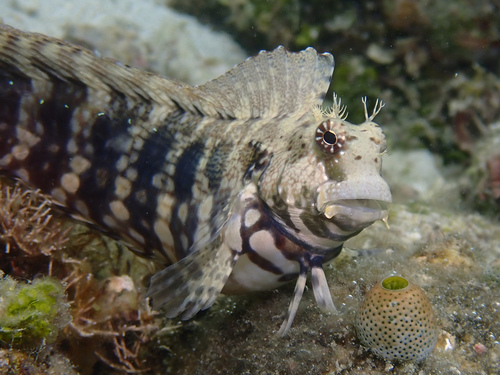
Jewelled Blenny
Salarias fasciatus
Meet the 'Lawnmower Blenny,' a master of camouflage and the most industrious gardener of the Indo-Pacific reefs. With its jewel-spotted skin and expressive personality, it is a favorite for underwater observers and reef-watchers alike.
Quick Identification
Size
Typically grows to a length of 10–14 cm (4–5.5 inches).
Colors
Mottled olive-green, tan, and brown body with dark vertical bars and numerous pale blue or white 'jewelled' spots; fins are typically translucent with brown speckling.
Key Features
- Blunt, sloping head with large eyes positioned high
- Branched, hair-like cirri above the eyes and on the nostrils
- Long, continuous dorsal fin often held erect while perching
- Comb-like teeth used for scraping surfaces
When You’ll See Them
Geographic range
Where Does the Jewelled Blenny Live?
The Jewelled Blenny is native to the vast Indo-Pacific region, flourishing in the warm tropical waters that stretch from the Red Sea and the eastern coast of Africa across to Samoa. Its core populations are found throughout the Indonesian archipelago, the Philippines, and the Great Barrier Reef of Australia, reaching as far north as the Ryukyu Islands of Japan. Within these regions, it is a dominant resident of shallow, sun-drenched reef flats where biological film grows rapidly on the seabed.
Basemap © OpenStreetMap contributors
Behavior
The Jewelled Blenny is a charismatic, bottom-dwelling fish that spends most of its time 'perching' on rocks or coral heads using its sturdy pectoral fins. Unlike many fish that swim continuously, this species moves in short, hopping bursts, making it a fascinating subject for stationary cameras. It is highly territorial and will often establish a 'home base' in a specific rock crevice, which it defends against other blennies and similarly sized competitors.
Known for its expressive face and constant grazing, it is an industrious worker that spends daylight hours scraping organic matter from the substrate. While it is generally shy toward large intruders, it can become quite bold once it acclimates to a specific area, often peering curiously at camera lenses or moving close to the glass in home reef environments. Its most remarkable behavioral trait is its ability to change its skin tone and pattern within seconds to perfectly match the surrounding rubble or algae.
EverydayEarth exclusive
Camera Tips
To capture the Jewelled Blenny on camera in a backyard tide pool or reef setting, you must focus on 'perch points.' These fish have a favorite high spot—usually a flat-topped rock or a prominent piece of coral rubble—where they sit to survey their territory. Position your waterproof camera on a weighted base about 12 inches away from such a spot, ensuring the lens is at the fish's eye level to capture its unique facial features and branched cirri.
Because they are masters of camouflage, standard motion detection can sometimes fail. For the best results, use a high-frequency time-lapse setting (one photo every 15–30 seconds) or a video trigger with high sensitivity. If you are monitoring a coastal pool, the hour surrounding low tide is the best time for filming, as the water is still and the fish is confined to a smaller, more predictable area.
Lighting is the biggest challenge underwater. If your 'backyard' is a shallow reef, try to film during mid-day when the sun is directly overhead to penetrate the water and highlight the iridescent 'jewelled' spots on the blenny's flanks. Avoid using bright artificial lights at night, as this species is diurnal and will simply hide in its crevice after dark. To keep the blenny in frame longer, you can secure a small piece of dried seaweed (nori) to a rock using a rubber band directly in front of the camera lens.
Similar Species
Species that look similar or are commonly confused with Jewelled Blenny.
Frequently Asked Questions
Record Jewelled Blenny at your habitat
Connect a camera to start building your own species record — AI identifies every visitor automatically.