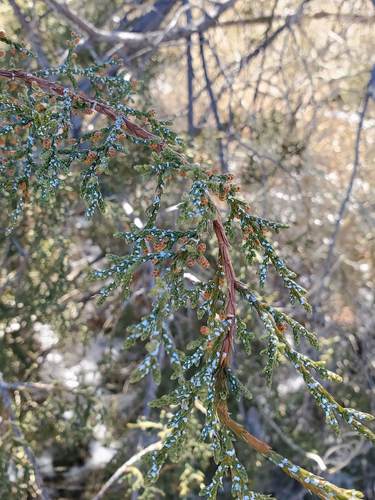
Juniper Scale
Carulaspis juniperi
Don't let their tiny size fool you—the Juniper Scale is a master of suburban camouflage. These armored invaders can turn a vibrant evergreen into a ghost of its former self, one needle at a time.
Quick Identification
Size
Adult females are 1–1.5 mm (0.04–0.06 in) in diameter; males are significantly smaller and narrower.
Colors
Dirty white or grayish circular armor with a distinctive yellow to orange-yellow center.
Key Features
- Circular, convex white or gray scales on needles
- Yellowish-orange raised center (exuviae) on female armor
- Foliage appears yellowed, brown, or 'ashy' in heavy infestations
- Tiny, mobile yellow 'crawlers' visible in late spring
When You’ll See Them
Behavior
The Juniper Scale is a sedentary specialist that spends the vast majority of its life tucked under a waxy, protective shield. Once a female 'crawler' finds a suitable spot on a juniper or arborvitae needle, she inserts her needle-like mouthparts to feed on plant juices and never moves again. This stationary lifestyle makes them easy to overlook until their numbers swell into the thousands, creating a 'crusty' or 'snow-covered' appearance on the host plant's inner branches.
These insects follow a strict seasonal timeline, typically producing only one generation per year. In late spring, the eggs protected beneath the female's armor hatch into mobile nymphs known as 'crawlers.' This is the only time the species is truly active, as these microscopic yellow specks wander the plant or are carried by the wind to neighboring trees. While they don't interact with humans directly, their feeding can cause significant dieback in backyard privacy screens and ornamental evergreens.
EverydayEarth exclusive
Camera Tips
Capturing the Juniper Scale requires a different approach than filming birds or mammals because of their diminutive size and lack of movement. To successfully document them, you will need a camera with macro capabilities or a high-resolution sensor that allows for significant cropping. Mount your camera on a steady tripod or a flexible arm attached directly to the shrub. Position the lens just inches away from a branch that shows signs of 'ashy' discoloration or yellowing needles. Natural, side-angled sunlight is your best friend here, as the waxy white shells reflect light, making them pop against the dark green of the foliage.
The most exciting time to use your camera is during 'crawler' season, which typically occurs in late May or June depending on your local climate. You can set up a time-lapse sequence on a single branch to catch the movement of these tiny yellow dots as they emerge from beneath the mother scales. Because these insects are too small to trigger standard motion sensors, use a 'scheduled capture' setting to take a high-resolution photo every 15 to 30 minutes during the day. This can help you monitor the spread and density of the colony over time.
For the best results, look for the most heavily infested areas, which are often the interior branches or the side of the plant facing away from the prevailing wind. If your camera has a 'micro' mode, use it to capture the texture of the armor; look for the distinct yellow-orange 'boss' or center point on the circular female scales. To identify the mobile stage, you can place a piece of double-sided black tape around a branch near the scales; the yellow crawlers will get stuck to it, providing a high-contrast subject for a macro photo. Ensure your camera is angled to catch the undersides of the needles, where these pests often congregate to avoid direct exposure to heavy rain.
Similar Species
Species that look similar or are commonly confused with Juniper Scale.
Frequently Asked Questions
Record Juniper Scale at your habitat
Connect a camera to start building your own species record — AI identifies every visitor automatically.