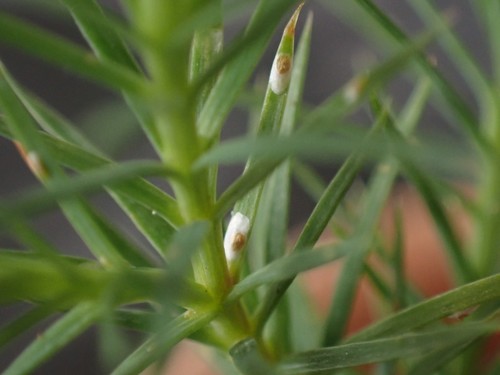
minute cypress scale
Carulaspis minima
A microscopic architect of the evergreen world, the minute cypress scale hides beneath a snowy white shield. These tiny armored insects may be small, but their colonies tell a fascinating story of survival and specialization in your backyard trees.
Quick Identification
Size
0.5 mm to 1.5 mm (0.02 to 0.06 inches) in diameter
Colors
Bright white to grayish-white waxy covers with a distinct yellow or tan central spot
Key Features
- Tiny circular white 'shields' on evergreen needles
- Small yellow/tan central dot (exuviae)
- Stationary, crust-like appearance on twigs
- Males are smaller and more oval/elongated than females
When You’ll See Them
Behavior
The minute cypress scale is a sedentary specialist that spends almost its entire life under a protective, waxy canopy. Once the 'crawler' (nymph) stage finds a suitable spot on a host plant, it inserts its mouthparts and never moves again. This armored insect secretes a hard, circular shell that acts as a fortress against predators like ladybugs and environmental hazards like heavy rain or wind.
While they appear lifeless to the naked eye, these insects are busy feeding on the internal fluids of their host tree. They are often found in massive colonies, clustering so tightly together that they can make a green branch appear as though it has been dusted with flour or flecked with white paint. Their social structure is non-existent; they are simply aggregate feeders drawn to the same nutrient-rich locations on the plant.
EverydayEarth exclusive
Camera Tips
Documenting the minute cypress scale requires a departure from standard wildlife photography. Because these insects are microscopic, a traditional trail camera will only see them as a blurry white haze on a branch. To truly capture them for AI identification, you must use a camera equipped with a high-quality macro lens or a digital microscope attachment. Set your camera on a sturdy tripod or use a specialized branch clamp, as the depth of field at this magnification is razor-thin; even a slight breeze moving the branch will throw the image out of focus.
Lighting is the most critical factor for these white insects. Direct, harsh sunlight will reflect off their waxy 'armor' and blow out the details. Instead, aim for bright, indirect light or use a diffuser over your LED flash. The goal is to capture the texture of the white shell and the tiny yellow 'button' in the center, which is the key diagnostic feature for the Carulaspis genus. If your camera has a 'focus stacking' feature, use it to ensure the entire colony is in sharp relief from the front to the back of the needle.
If you want to capture movement, timing is everything. The only stage of the minute cypress scale that moves is the 'crawler' stage, which typically occurs in late spring. Set your camera to record high-definition time-lapse video during the warmest part of the day in May or June. You may see the tiny, yellowish specks emerging from under the mother scales to find new territory. This is the best time to see the 'live' side of this otherwise stationary species.
Similar Species
Species that look similar or are commonly confused with minute cypress scale.
Frequently Asked Questions
Record minute cypress scale at your habitat
Connect a camera to start building your own species record — AI identifies every visitor automatically.