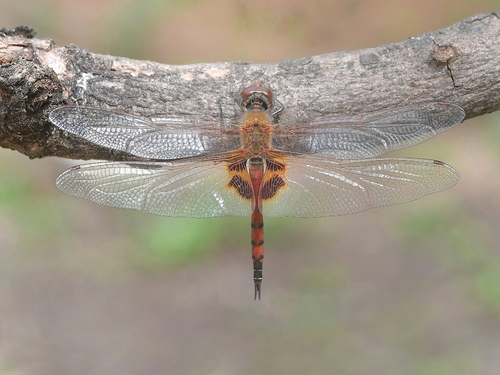
Keyhole Glider
Tramea basilaris
A master of the trade winds, the Keyhole Glider is a vibrant red voyager famous for its trans-oceanic journeys. With its unique 'windowed' wing patches and effortless gliding flight, it brings a touch of global wandering to your backyard garden.
Quick Identification
Size
Body length of 1.7-2.0 inches (45–50 mm); wingspan of 2.9-3.5 inches (75–90 mm)
Colors
Males are vibrant cherry-red with dark brown patches on the hindwings; females are olive-brown with similar wing markings
Key Features
- Large dark brown patches at the base of hindwings containing a clear 'window' or keyhole shape
- Bright red abdomen with black markings on the final segments (males)
- Long, broad hindwings designed for gliding
- Large reddish-brown compound eyes that meet at the midline
When You’ll See Them
Behavior
The Keyhole Glider is a true wanderer of the insect world, known for its incredible ability to travel thousands of miles across oceans and continents using trade winds. Unlike many dragonflies that stay close to a single pond, these insects are nomadic. They are frequently seen 'gliding' on thermals, using their broad hindwings to stay aloft with minimal effort. They are highly social during migration and can sometimes be seen in large swarms following weather fronts.
In a backyard setting, you'll likely see them patrolling high above the ground rather than perching for long periods. They are non-territorial, which is unusual for dragonflies, meaning they are less likely to chase off other insects and more likely to focus on foraging. During mating, they often form a 'tandem' or 'wheel' formation while flying, which is a spectacular sight for any nature observer.
EverydayEarth exclusive
Camera Tips
Capturing a Keyhole Glider on camera requires a different approach than filming birds or mammals. Since these dragonflies spend most of their time in the air, you should position your camera near 'perching hotspots' if they aren't actively migrating. Look for tall, dry stalks of grass, bamboo stakes, or the tips of thin branches near a water feature. Set your camera on a tripod at roughly 3 to 5 feet (1-1.5 meters) above the ground, angled slightly upward to catch the underside of the wings against the sky, which highlights the distinctive 'keyhole' markings.
Because they move exceptionally fast, a high shutter speed or a high-frame-rate video setting is essential. If your camera supports AI-triggering, set it to 'Small Animal' or 'Insect' mode to reduce lag time. Unlike mammals, Keyhole Gliders aren't attracted to food bait, but they are highly attracted to water. A birdbath with a few flat stones for perching or a small backyard pond will drastically increase your chances of a close-up shot. Position the camera about 2 feet away from these potential landing spots for the best detail.
Lighting is your best friend with this species. They are most active during the brightest parts of the day when the sun is high. Aim your camera so the sun is behind you or to the side; this illuminates the vibrant red of the male's body and makes the translucent wings 'pop' against the background. In the late afternoon, you might catch them resting as they cool down; this is the best time for high-resolution stills as they are less likely to take flight immediately when approached by a camera lens.
Similar Species
Species that look similar or are commonly confused with Keyhole Glider.
Frequently Asked Questions
Record Keyhole Glider at your habitat
Connect a camera to start building your own species record — AI identifies every visitor automatically.