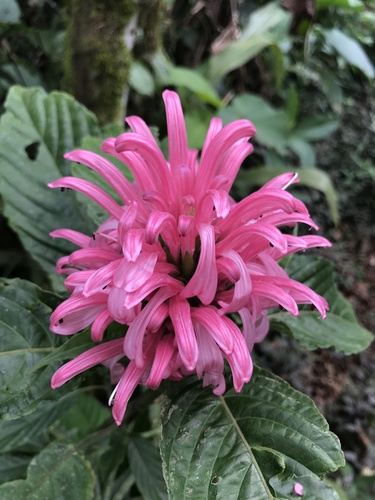
King's-crown
Justicia carnea
The King's-crown is a tropical masterpiece that turns shaded garden corners into vibrant wildlife theaters. Its explosive pink plumes act as a natural beacon for hummingbirds and butterflies seeking a high-energy nectar feast.
Quick Identification
Size
Grows 1.2–2.1 m (4–7 ft) tall with a spread of 0.6–0.9 m (2–3 ft)
Colors
Large rose-pink to deep crimson tubular flowers; dark green, veined leaves with occasional purple undersides
Key Features
- Upright, plume-like flower spikes 10–20 cm long
- Large, opposite, lance-shaped leaves with prominent veins
- Squared stems characteristic of the acanthus family
- Shade-tolerant, shrubby growth habit
When You’ll See Them
Geographic range
Where Does the King's-crown Live?
King's-crown is native to the lush Atlantic Forest regions of South America, specifically eastern and southern Brazil. Because of its stunning ornamental value, it has been introduced and naturalized across many tropical and subtropical regions worldwide, including Central America, the Caribbean, and the Galapagos Islands. In North America, it thrives as a perennial in the frost-free zones of Florida, the Gulf Coast, and Southern California, while often being kept as a container plant in more temperate climates.
Basemap © OpenStreetMap contributors
Behavior
King's-crown is an evergreen perennial shrub known for its dramatic, exploding floral displays that brighten shaded environments. Unlike many tropical plants that require full sun, this species has adapted to thrive in the understory, making it a vital nectar source in dappled-light habitats. It blooms in flushes from early summer through the first frost, producing dense terminal clusters of curved, tubular flowers.
While the plant itself is stationary, it behaves as a central hub for backyard biodiversity. Its high nectar production creates a predictable daily schedule for local pollinators. It is a resilient grower but communicates its needs clearly through its foliage; its large leaves will conspicuously wilt when thirsty, recovering quickly once watered, which makes it an excellent indicator plant for garden health.
EverydayEarth exclusive
Camera Tips
To capture the most exciting wildlife activity, position your camera approximately 3 to 4 feet away from the most vibrant flower plumes. King's-crown is a premier 'hummingbird magnet,' and these birds usually approach the flowers from the side or top to access the nectar tubes. Setting your camera at eye level with the blooms will provide the best angle for capturing the iridescent feathers and hovering action of visitors like the Ruby-throated or Black-chinned hummingbird.
Because this plant thrives in shade, lighting can be a challenge for trail cameras. Look for a spot where a shaft of morning sun hits the flowers to trigger better color sensors in your AI camera. If your device allows for shutter speed adjustments, use a high-speed setting to freeze the rapid wingbeats of the butterflies and hummingbirds that are inevitably drawn to the pink plumes. Use a 'Zone Trigger' setting if available, focusing specifically on the space 6 inches in front of the flower heads.
In addition to birds, keep your camera running during the afternoon to catch various swallowtail butterflies and sphinx moths. Avoid using heavy baits near the plant, as the natural nectar is more than enough to lure the target species. Instead, ensure the plant is well-watered; a turgid, healthy King's-crown produces more nectar and maintains its upright 'crown' shape, making for much more aesthetic and successful captures during the peak summer flowering season.
Similar Species
Species that look similar or are commonly confused with King's-crown.
Frequently Asked Questions
Record King's-crown at your habitat
Connect a camera to start building your own species record — AI identifies every visitor automatically.