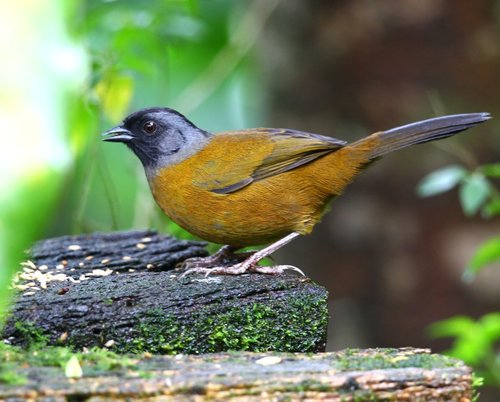
Large-footed Finch
Pezopetes capitalis
An oversized sparrow of the misty highlands, the Large-footed Finch is easily identified by its bold crown stripes and its habit of noisily scratching through the cloud forest floor.
Quick Identification
Size
20–21 cm (7.8–8.3 in) in length; weighs approximately 45–56 g (1.6–2.0 oz)
Colors
Dull olive-green body with a gray head featuring bold black stripes on the crown; black mask around eyes; heavy dark legs and feet
Key Features
- Oversized dark gray feet and legs
- Bold black crown stripes on a gray head
- Chunky, towhee-like build
- Olive-green plumage with brighter yellow-olive underparts
When You’ll See Them
Geographic range
Where Does the Large-footed Finch Live?
Native to the Central American highlands, the Large-footed Finch is found exclusively in the lofty mountain ranges of Costa Rica and western Panama. Its core range spans the Cordillera Central and the Talamanca mountains, reaching into the Chiriquí province of Panama. This species is a true highland specialist, appearing only at high elevations where the climate remains cool and misty year-round.
Basemap © OpenStreetMap contributors
Behavior
The Large-footed Finch is a charismatic and surprisingly bold ground-dweller. Despite its name, it is actually a member of the American sparrow family and behaves much like a towhee. It is famous for its energetic foraging style, often using a 'double-scratch' technique where it hops forward and kicks backward with both feet simultaneously to uncover insects hidden in the leaf litter. While they can be shy in dense forest interiors, they are often quite curious around mountain lodges and gardens, sometimes hopping within a few feet of quiet observers.
These birds are typically found in pairs or small family groups. They spend the vast majority of their time on the forest floor or in low bamboo thickets, rarely flying high into the canopy. Their song is a series of thin, high-pitched squeaks and whistles that can be difficult to locate in the misty highland air, but their constant rustling in the leaves is a dead giveaway of their presence.
EverydayEarth exclusive
Camera Tips
To capture the Large-footed Finch, you must think low. These birds are almost exclusively terrestrial, so mount your AI-powered camera on a stake or tree base no higher than 6 to 10 inches off the ground. Aim the lens at a flat patch of leaf litter near the edge of a bamboo thicket or a garden border. Because they are active foragers, a wide-angle view is better than a tight zoom to catch them as they hop and scratch across the frame.
Using a high frame rate or video mode is highly recommended to document their unique double-scratch foraging behavior. This motion often happens quickly, so a fast trigger speed is essential. In the humid cloud forest environment, ensure your camera housing is well-sealed against moisture and check the lens frequently for fogging or water droplets, which are common in their high-altitude habitat.
While they are naturally curious, you can encourage them to linger in front of the camera by providing a shallow, ground-level birdbath or by lightly disturbing the soil to reveal grubs and insects. They are most active during the misty early morning hours when the light is soft, so ensure your camera's low-light sensors are optimized for high-contrast shade.
Similar Species
Species that look similar or are commonly confused with Large-footed Finch.
Frequently Asked Questions
Record Large-footed Finch at your habitat
Connect a camera to start building your own species record — AI identifies every visitor automatically.