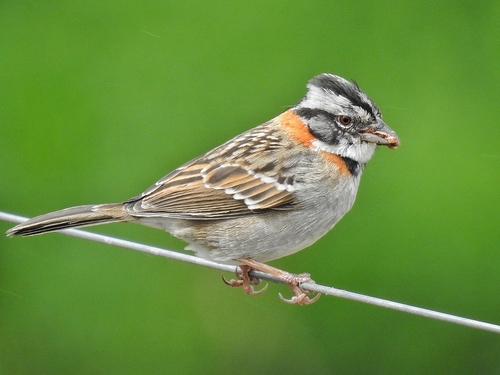
Rufous-collared Sparrow
Zonotrichia capensis
With its dapper reddish collar and soulful regional song, the Rufous-collared Sparrow is the quintessential backyard companion of the Americas. This bold little bird brings a touch of Andean elegance to any garden camera feed.
Quick Identification
Size
Length: 13–15 cm (5.1–5.9 in); Weight: 20–25 g (0.7–0.9 oz)
Colors
Gray crown with black stripes, prominent rufous (reddish-brown) collar on the nape, white throat with black borders, and brownish-streaked upperparts.
Key Features
- Distinctive reddish-brown (rufous) collar encircling the back of the neck
- Gray head featuring bold black stripes and a small, often raised crest
- Bright white throat patch framed by black lateral stripes
- Sturdy, conical seed-eating bill and brownish-gray underparts
When You’ll See Them
Behavior
The Rufous-collared Sparrow is a remarkably bold and adaptable bird, often becoming the most visible visitor in backyard settings throughout Central and South America. They are famous for their regional 'dialects,' with complex, whistling songs that vary significantly from one valley or city to the next. In suburban areas, they are frequently seen hopping confidently across patios, lawns, and garden paths, showing little fear of human activity.
Socially, they are usually found in pairs or small family units. They spend a vast majority of their time on the ground, utilizing a specialized 'double-scratch' hopping technique—kicking both feet back simultaneously to uncover seeds or insects hidden beneath leaf litter. They are highly territorial during the breeding season but maintain a cheerful, active presence in gardens year-round.
EverydayEarth exclusive
Camera Tips
To get the best shots of a Rufous-collared Sparrow, keep your camera low. These birds are almost exclusively ground-feeders, so a camera mounted on a stake just 6 to 10 inches off the ground or placed directly on a flat stone will capture their most natural behaviors. Position your lens to face a patch of open soil or a short-grass area near the base of a dense shrub, as they like to have a quick escape route into the foliage if a predator appears.
Attracting them to your camera's field of view is best achieved with ground-level baiting. Scatter fine birdseed, millet, or cracked corn directly on the ground rather than using a hanging feeder. If you want to capture their unique 'double-scratch' foraging behavior, place the seed under a light layer of dry leaves. Additionally, a very shallow water feature, like a terracotta saucer, is an irresistible lure for these birds during the warmer parts of the afternoon, often resulting in high-energy bathing footage.
Lighting is the final key to a 'hero' shot. The rufous collar that gives this bird its name can look dull in deep shade but glows brilliantly in soft, angled sunlight. Try to orient your camera facing North or South to take advantage of the 'Golden Hour' light without the sun shining directly into the lens. Because they are most active right at dawn, ensure your AI camera is set to a high-sensitivity trigger so you don't miss their first morning foraging run, which is often their most active time of the day.
Similar Species
Species that look similar or are commonly confused with Rufous-collared Sparrow.
Frequently Asked Questions
Record Rufous-collared Sparrow at your habitat
Connect a camera to start building your own species record — AI identifies every visitor automatically.