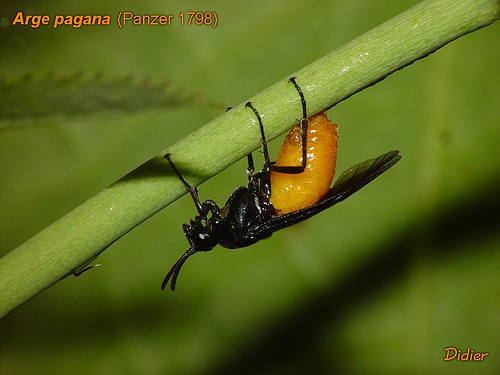
Large Rose Sawfly
Arge pagana
A striking visitor to the summer garden, the Large Rose Sawfly is easily identified by its vibrant orange abdomen and glossy black wings. Watch your rose bushes closely to see these 'saw-bearing' insects in action.
Quick Identification
Size
Adults measure 8–10 mm (0.3–0.4 inches) in length with a wingspan of approximately 15–18 mm (0.6–0.7 inches).
Colors
Glossy black head and thorax with a vibrant yellow to orange abdomen; wings are distinctly smoky or dark-tinted.
Key Features
- Shiny all-black thorax and head
- Bright orange or yellow abdomen
- Dark smoky-colored wings
- Larvae are pale green with numerous small black spots
When You’ll See Them
Behavior
The Large Rose Sawfly is named for the female's specialized egg-laying organ, which functions like a tiny serrated saw. She uses this to slice into the soft green stems of rose bushes to deposit her eggs in neat rows. While the adults are often seen hovering around flowers or sunning themselves on leaves, they are relatively slow flyers compared to wasps or bees, making them easier to spot and track with a camera.
The larvae are highly social and are typically found feeding in groups on the edges of rose leaves. When disturbed, they exhibit a unique defensive posture, arching their bodies into an 'S' shape to deter predators. Despite their common name, they are not true flies or wasps, but belong to an ancient lineage of insects that lack the 'wasp waist' seen in their more famous cousins.
EverydayEarth exclusive
Camera Tips
To capture high-quality footage of the Large Rose Sawfly, position your AI camera within 12 to 24 inches of a rose bush, specifically targeting the tender new growth or the undersides of the leaves. Because these insects are relatively small, a camera with a macro lens or a close-focus setting is ideal. Try to angle the camera so it is level with the rose stems; this increases your chances of filming the female's fascinating 'sawing' behavior as she deposits eggs inside the plant tissue.
Lighting is crucial for these shiny insects. Aim for a spot that receives dappled sunlight. Direct, harsh midday sun can create glare on their glossy black thoraxes, while too much shade may result in grainy footage. If you are using a trigger-based camera, set it to its most sensitive motion setting, as the movement of a single sawfly can be subtle. To increase the 'dwell time' of adults in front of your lens, consider placing the camera near nectar-rich white flowers like Hogweed or Elderflower planted adjacent to your roses.
For larval activity, look for rose leaves that show signs of 'skeletonization' or heavy munching along the edges. Placing your camera near these feeding sites will capture the gregarious larvae in action. Since they move slowly while feeding, this is a great opportunity to use time-lapse settings to watch them move across a single leaf over several hours. Peak activity for the first generation occurs in late spring, with a second wave often appearing in mid-to-late summer.
Similar Species
Species that look similar or are commonly confused with Large Rose Sawfly.
Frequently Asked Questions
Record Large Rose Sawfly at your habitat
Connect a camera to start building your own species record — AI identifies every visitor automatically.