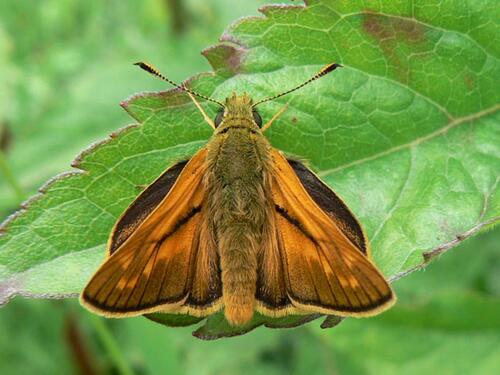
Large Skipper
Ochlodes sylvanus
Meet the 'jet fighter' of the butterfly world. With its stout, furry body and unique angled-wing resting pose, the Large Skipper is a golden-brown marvel that adds a dash of speed and spirit to summer gardens.
Quick Identification
Size
Wingspan of 33-35 mm (1.3 to 1.4 inches); body length approx 15-20 mm.
Colors
Rich orange-brown upper wings with dark brown borders. Males feature a prominent black 'sex brand' (line) on the forewing, while females have paler yellow-orange markings.
Key Features
- Thick, moth-like body with a furry appearance
- Hooked tips on the ends of the clubbed antennae
- Unique resting posture with forewings held at 45 degrees and hindwings flat
- Vague, light-colored square spots on the greenish-yellow underside of the hindwing
When You’ll See Them
Behavior
When not defending territory, they are frequent nectar-feeders and basking enthusiasts. They use a specific wing posture—forewings angled up and hindwings flat—to maximize heat absorption from the sun. This 'jet fighter' pose is a classic characteristic of the skipper family. They are relatively approachable compared to other species, often returning to the same favorite perch even if momentarily disturbed.
As a species that overwinters in its larval stage, the Large Skipper relies on undisturbed tall grasses. In the garden, they act as excellent indicators of a healthy, biodiverse environment. While they are solitary in their territorial defense, you may find several individuals in a small area if nectar sources like bramble or thistles are abundant.
EverydayEarth exclusive
Camera Tips
Because Large Skippers are relatively small, use a camera with a dedicated macro mode or a high-resolution sensor that allows for cropping. If your AI camera has adjustable trigger zones, focus them on the tops of flower heads like thistles or knapweed. These are high-traffic foraging areas where the butterfly will stay still for several seconds at a time, providing the perfect window for a clear shot. Avoid placing cameras in deep shade, as these sun-loving insects will rarely visit areas without direct solar heat.
For the most dramatic footage, try to capture their 'take-off.' Set your camera to a high frame rate or burst mode. Because they are territorial, a male will often return to the exact same leaf after chasing an intruder. If you see one land, wait—it is very likely to return to that spot, allowing you to fine-tune your focus and framing for the next visit. Use a fast shutter speed (at least 1/1000s) to freeze their rapid wing movement.
Finally, consider the background. To make the orange-brown of the Large Skipper 'pop' in your photos, aim your camera toward a backdrop of darker green foliage or a shadowed area. This contrast highlights the golden hues of their wings. If you are struggling to attract them, placing a small 'puddling' station (a shallow dish with damp sand and a pinch of salt) nearby can sometimes lure them in for essential minerals, though they prefer nectar for energy.
Similar Species
Species that look similar or are commonly confused with Large Skipper.
Frequently Asked Questions
Record Large Skipper at your habitat
Connect a camera to start building your own species record — AI identifies every visitor automatically.