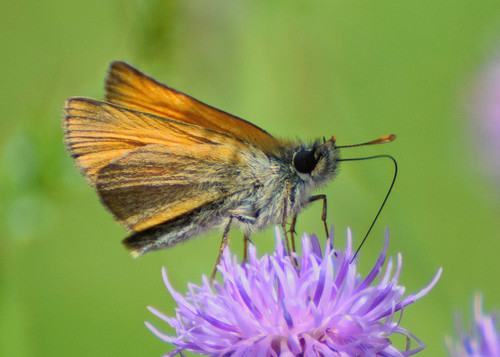
Small Skipper
Thymelicus sylvestris
A golden-orange spark in the summer grass, the Small Skipper is the engine of the meadow. Watch for its unique 'jet-plane' wings and lightning-fast flight as it darts between your garden flowers.
Quick Identification
Size
Wingspan of 25–30 mm (0.98–1.18 inches)
Colors
Bright golden-orange wings with narrow dark borders and dark veins; males have a thin black 'sex brand' line on the forewings.
Key Features
- Bright orange wing color with dark veins
- Antennae tips have orange undersides (unlike the black-tipped Essex Skipper)
- Characteristic 'jet plane' resting posture with forewings angled up
- Small, jerky, darting flight pattern
- Smooth, golden-brown appearance without heavy mottling
When You’ll See Them
Behavior
The Small Skipper is a high-energy butterfly that lives up to its name with a distinctive 'skipping' flight pattern. Instead of the graceful, sweeping glides seen in larger butterflies, this species moves in rapid, erratic bursts as it darts from one flower to another. They are highly territorial and sun-dependent; you will often see them battling for the best perching spot on a thistle or a tall blade of grass when the sun is at its peak.
When resting, they adopt a unique posture that is a trademark of the skipper family: the hindwings are spread flat while the forewings are held upright at a 45-degree angle. This allows them to regulate their body temperature efficiently. They are social in the sense that many individuals can be found in a small area of habitat, but they don't form organized groups. During cloudy intervals, they quickly disappear, crawling deep into the grass for shelter.
EverydayEarth exclusive
Camera Tips
To successfully capture a Small Skipper on your backyard camera, you need to focus on 'refueling' stations rather than open space. These butterflies are too small and fast to reliably trigger most PIR motion sensors from a distance. Position your camera just 12 to 24 inches away from nectar-rich flowers like Lavender, Marjoram, or Buddleia. If your camera has a macro setting or an adjustable focus ring, use it to ensure the fine details of their wings and antennae are sharp.
Lighting is the most critical factor for this species. Set your camera facing south or southeast so the morning and midday sun illuminates their golden-orange wings. Because they are light-bodied and may not always trigger a motion event, the 'Time Lapse' mode is your best friend. Set your camera to take a photo or short video every 10 to 15 seconds during the peak hours of 10 AM to 3 PM on sunny days. This ensures you catch them while they are stationary and feeding.
Another pro-tip is to provide a 'basking stage' within the camera's field of view. A flat, light-colored stone placed in a sunny spot near their favorite flowers often becomes a regular landing pad for skippers looking to warm up. If your camera supports high-speed video (60fps or higher), use it! Their wing movements are incredibly fast, and standard frame rates often result in a motion blur that hides the beauty of their 'jet-wing' posture. Avoid placing the camera where tall grass in the background will blow in the wind, as this will create hundreds of empty trigger events.
Similar Species
Species that look similar or are commonly confused with Small Skipper.
Essex Skipper
Nearly identical but has black undersides on the antenna tips, whereas the Small Skipper has orange.
Large Skipper
Larger with more prominent dark mottling on the wings and distinct hooks at the ends of the antennae.
Lulworth Skipper
Smaller and more olive-brown in color, with a much more restricted range in coastal areas.
Frequently Asked Questions
Record Small Skipper at your habitat
Connect a camera to start building your own species record — AI identifies every visitor automatically.