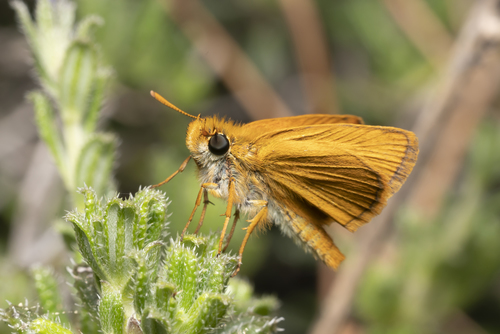
Lulworth Skipper
Thymelicus acteon
A golden-olive treasure of the southern coast, the Lulworth Skipper is one of Britain’s rarest and most localized butterflies. Watch for its energetic skip across the summer grasslands of Dorset.
Quick Identification
Size
Wingspan of 24–28 mm (approx. 1 inch); body length roughly 15-18 mm.
Colors
Dull olive-brown with a golden-orange dusting. Females feature a distinct 'sun-ray' circle of pale spots on the forewings, while males have a thin dark line (sex brand) on the forewing.
Key Features
- Olive-golden wings with a subtle metallic sheen
- Faint circle of pale spots on female forewings
- Pointed wing tips and stocky body
- Distinctive 'skipped' flight pattern close to the ground
When You’ll See Them
Behavior
The Lulworth Skipper is a sun-loving butterfly known for its energetic and erratic flight, which often looks like it is skipping over the tops of tall grasses. Unlike many wider-ranging butterflies, this species is highly sedentary and tends to live in tight-knit colonies. They are most active during the warmest parts of the day, frequently stopping to bask on leaves with their wings held in a unique 'half-open' position characteristic of the skipper family.
While they are shy around large movements, they are incredibly focused when feeding. You will often find them competing for nectar on purple-flowered plants. Because they have a very limited range in the UK, their presence is a sign of a healthy, undisturbed chalk grassland ecosystem. They do not migrate, meaning the individuals you see in your garden or local field likely spent their entire life cycle within a few hundred meters of that spot.
EverydayEarth exclusive
Camera Tips
Capturing the Lulworth Skipper on a backyard or trail camera requires a specialized approach due to its small size and specific habitat. To get high-quality footage, you should position your AI camera within 12 to 24 inches of nectar-rich flowers like Greater Knapweed or Vipers Bugloss. Use a macro lens attachment if your camera supports it, as the fine golden scales on their wings are stunning when seen in high detail. Set your camera at a height of about 2 feet off the ground, angled slightly upward to catch the underside of the wings when they land.
Since these butterflies are highly sensitive to the sun, place your camera in a south-facing spot that receives full light between 11 AM and 2 PM. This is when the skippers are most active and likely to sit still for basking. If you are using a triggered camera, ensure the shutter speed is set as high as possible (at least 1/1000s) to freeze their rapid wing movements. Using a 'burst mode' or short video clips is often more effective than single photos for this species.
For the best results, look for patches of tall, 'messy' grass nearby—specifically Tor-grass. If you can position your camera near the edge where long grass meets nectar flowers, you catch them in their transition zone. Avoid using artificial lures or baits; instead, ensure you have a fresh water source or 'puddling' station (a damp patch of sandy soil) nearby, which can attract them during particularly hot Dorset summers. Keep the camera lens clean from salt spray if you are filming near the coast, as even a thin film can blur the delicate patterns on the skipper's wings.
Similar Species
Species that look similar or are commonly confused with Lulworth Skipper.
Small Skipper
Brighter orange wings without the olive tint; lacks the pale 'sun-ray' spots on the forewings.
Essex Skipper
Almost identical to the Small Skipper but features solid black undersides to the tips of its antennae (the 'black-tipped matches' look).
Silver-spotted Skipper
Larger and chunkier with very distinct white/silver rectangular spots on the underside of the hindwings.
Frequently Asked Questions
Record Lulworth Skipper at your habitat
Connect a camera to start building your own species record — AI identifies every visitor automatically.