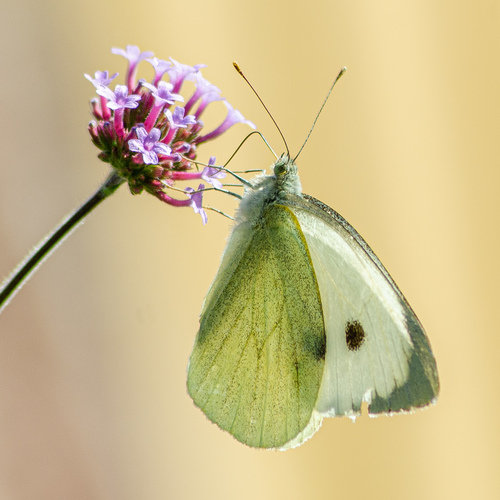
Large White
Pieris brassicae
A bold and powerful flyer, the Large White is a staple of the summer garden. Known for its brilliant white wings and distinct black markings, it is as much a favorite of nature lovers as it is a challenge for vegetable gardeners.
Quick Identification
Size
Wingspan of 57–66 mm (2.2–2.6 inches)
Colors
Brilliant white wings with prominent black tips on the forewings; females have two distinct black spots on each forewing which males lack.
Key Features
- Large white wings with deep black tips extending down the outer edge
- Females feature two circular black spots on the upper forewing
- Underwings are a pale, creamy yellow-green with fine black speckling
- Powerful, erratic flight pattern compared to smaller relatives
When You’ll See Them
Behavior
The Large White is a strong and restless flier, often seen fluttering through gardens and over hedgerows with a purposeful, looping motion. Unlike many other butterflies that remain localized, this species is highly mobile and well-known for its migratory habits, sometimes appearing in vast numbers as they move across territories in search of fresh breeding grounds and nectar sources.
In the backyard, they are frequent visitors to both flower borders and vegetable patches. While adults spend their time sipping nectar, they are also constantly scouting for suitable host plants. They are unique among the 'white' butterflies because they lay their eggs in large clusters of up to 100, leading to communal groups of caterpillars that can quickly defoliate a host plant. This social behavior in the larval stage is a key survival strategy against predators.
EverydayEarth exclusive
Camera Tips
To capture the best footage of a Large White, your camera placement is everything. Since these butterflies are drawn to specific 'host' plants, positioning your camera near a patch of kale, cabbage, or nasturtiums is a guaranteed way to see them. Focus your lens on the undersides of the leaves if you want to capture the egg-laying process, or aim at the tops of the plants where they land to rest and sun themselves. Because they are larger than most garden butterflies, they trigger PIR sensors more reliably, but you should still set your camera to its highest sensitivity.
For those using AI-powered cameras with nectar-rich feeders or flower-mounted setups, focal distance is your biggest challenge. Most standard trail cameras have a minimum focus distance of about 3 to 5 feet. If you place the camera closer to a flower head for a macro-style shot, the image will be blurry. Use a camera specifically designed for close-up wildlife or adjust your mounting height to at least 4 feet away from a blooming Buddleia or Lavender bush to ensure the wing markings are crisp and identifiable.
Lighting plays a critical role in butterfly photography. Large Whites are most active on bright, still days. Position your camera so the sun is behind it or to the side; direct backlighting can wash out the brilliant white of their wings, making them look like a glowing blur in the video. If your camera allows for adjustable shutter speeds or 'sport' modes, use them. Their wingbeats are fast, and a standard frame rate can sometimes result in 'motion ghosting' where the butterfly appears semi-transparent.
Don't forget the 'resting' shots. In the early morning (around 8-9 AM) or late afternoon, Large Whites often perch on tall grasses or flower stalks to regulate their body temperature. They move much slower during these periods, providing the perfect window for the AI to capture a high-resolution still image without the blur of active flight. Target these 'basking spots' for the most detailed species profiles.
Similar Species
Species that look similar or are commonly confused with Large White.
Frequently Asked Questions
Record Large White at your habitat
Connect a camera to start building your own species record — AI identifies every visitor automatically.