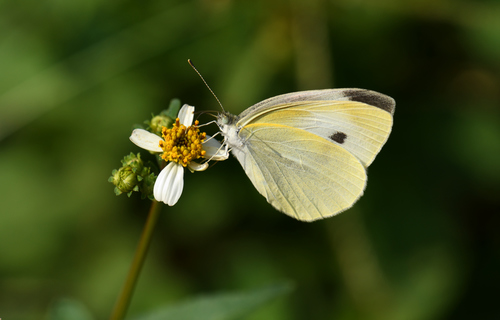
Small White
Pieris rapae
The Small White is the quintessential backyard butterfly, a snow-colored aerialist that brings life to every garden. While often called the 'Cabbage White,' this resilient pollinator is a master of adaptation and a delight to watch in motion.
Quick Identification
Size
Wingspan of 32–47 mm (1.25–1.85 inches); body length approximately 20-25 mm (0.8-1.0 inches)
Colors
Creamy white upper wings with charcoal-gray tips on the forewings. Males feature a single black spot on each forewing, while females have two. The undersides are a pale, camouflage-friendly yellowish-green.
Key Features
- Small charcoal-black tips on the forewings
- Creamy white upper wings with pale yellow undersides
- Single black spot (male) or double black spot (female) on forewings
- Erratic, bouncing flight pattern near ground level
When You’ll See Them
Behavior
The Small White is a highly active and visible butterfly, often seen fluttering through gardens and allotments with an erratic, 'bouncing' flight path. Unlike some more reclusive species, they are bold explorers of human-dominated landscapes, spending much of their day searching for nectar sources or suitable host plants for their eggs. They are often seen 'basking' with their wings partially open to soak up the morning sun, as they require solar heat to power their flight muscles.
Socially, they are mostly solitary, though you may see several congregating around a particularly rich nectar source or a 'puddling' site. In the garden, they are famous—or perhaps infamous—for their persistence in locating brassica plants. While the adults are beneficial pollinators, they are constantly on the move, rarely staying in one spot for more than a few seconds unless they are feeding or mating.
EverydayEarth exclusive
Camera Tips
To capture high-quality footage of the Small White, you need to think like a gardener. These butterflies are drawn to 'landing pads'—flat or clustered flowers. Instead of aiming your camera at wide open space, focus your lens directly on a specific nectar-rich plant like Buddleia (Butterfly Bush), Verbena bonariensis, or Lavender. Because these butterflies move quickly, set your camera to a fast shutter speed or 'Sports Mode' to avoid a white motion blur. If your camera supports burst photos, this is the best way to catch the exact moment their wings are fully spread.
Placement is critical for such a small subject. Position your camera approximately 12 to 24 inches away from your target flowers. If you are using a standard trail camera without a macro lens, you may need to use a 'close-up' lens attachment to ensure the butterfly is in focus. Angle the camera so it faces away from the direct sun; the Small White’s bright wings are highly reflective and can easily 'blow out' in harsh light, turning into a featureless white blob on digital sensors. Side-lighting during the mid-morning or late afternoon provides the best wing detail.
You can also use a 'puddling station' to lure them into a stationary position. Fill a shallow tray with damp sand and a tiny pinch of sea salt or a splash of compost tea. Butterflies, including the Small White, land on these damp patches to drink mineral-rich water. This provides a rare opportunity to film them while they are perfectly still for several minutes, allowing for much clearer identification and observation of their proboscis in action.
Finally, keep seasonality in mind. They produce multiple broods per year, so if you miss the first flight in spring, you’ll have another peak opportunity in mid-summer. During the hottest days, they are most active, so ensure your camera batteries are fresh for those long, sunny July afternoons when activity in the garden is at its absolute maximum.
Similar Species
Species that look similar or are commonly confused with Small White.
Large White
Noticeably larger with much broader, darker black tips on the forewings that extend further down the wing edge.
Green-veined White
Features prominent grey-green scales along the wing veins on the underside, which look like dark 'veins' compared to the Small White's plain yellow underside.
Orange-tip
Males are easily told apart by their bright orange wingtips; females lack the orange but have a distinct mottled green pattern on the underside of their wings.
Frequently Asked Questions
Record Small White at your habitat
Connect a camera to start building your own species record — AI identifies every visitor automatically.