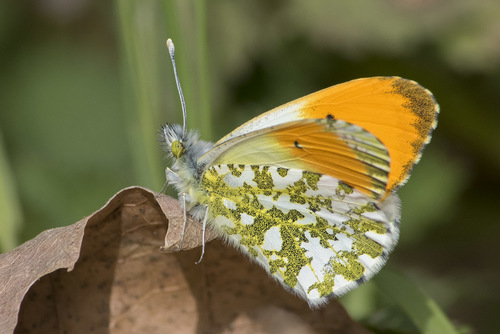
orange-tip
Anthocharis cardamines
A signature sign of spring, the orange-tip brings a splash of vibrant color to garden hedgerows. With its unique 'mossy' camouflage and wandering flight, it is a favorite for backyard observers and macro photographers.
Quick Identification
Size
Wingspan of 40–50 mm (1.6–2.0 inches); body length approx. 15–18 mm (0.6–0.7 inches)
Colors
Males have white wings with vibrant orange tips on the forewings; females are white with black tips. Both sexes have distinct moss-green mottled undersides.
Key Features
- Bright orange patches on outer forewings (males only)
- Intricate green and white 'marbled' pattern on the underside of hindwings
- Small black crescent or spot in the center of the forewing
- Single generation per year appearing only in spring
When You’ll See Them
Behavior
The orange-tip is one of the most charming harbingers of spring. Males are energetic patrollers, flying low and steadily along hedgerows, woodland edges, and garden borders in a relentless search for females. They are highly visible due to their bright coloration, whereas the females are much more discreet. Females spend their time searching for specific host plants to lay their eggs, often appearing more like other 'white' butterfly species until they land.
These butterflies are notably weather-dependent; you will see them most frequently on still, sunny days. When the sun goes behind a cloud or temperatures drop, they quickly find a resting spot among tall grasses or on flower heads. Because they only produce one brood per year, their entire adult life cycle—from emergence to mating and egg-laying—is compressed into a few short weeks between April and June.
EverydayEarth exclusive
Camera Tips
Capturing the orange-tip on a backyard camera requires a targeted strategy centered on their favorite spring flowers. Position your camera near 'magnet' plants like Garlic Mustard (Jack-by-the-hedge) or Cuckooflower. Since these butterflies often fly at a height of about 1 to 3 feet while patrolling, set your camera on a small tripod or stake at knee-height. A slightly upward angle is preferred; this increases the chance of capturing the stunning green marbling on the wing undersides when the butterfly lands to feed.
Because butterflies move quickly and are relatively small, standard motion-detecting trail cameras can sometimes be too slow. If your camera has a 'High Sensitivity' or 'Small Subject' PIR setting, enable it. Alternatively, use time-lapse mode with a short interval (e.g., one photo every 10-15 seconds) during the peak sunny hours of 11 AM to 2 PM. This 'brute force' method often captures incredible flight shots or landing sequences that motion sensors might miss.
Lighting is your best friend for this species. To make the male's orange wing-tips pop, ensure your camera is positioned so the sun is behind it, illuminating the butterfly directly. However, for the best macro-style detail of the wing patterns, a bright but slightly overcast day provides the softest, most even light. If you want to capture them roosting (which allows for the sharpest images), check your camera footage early in the morning or late in the evening when they are more likely to be stationary on flower heads.
Similar Species
Species that look similar or are commonly confused with orange-tip.
Small White
Lacks the green-mottled underside; the underside of its wings is a plain pale yellowish-white.
Green-veined White
Has dark-scaled veins on the underside of the wings rather than the blotchy, moss-like marbling of the orange-tip.
Large White
Significantly larger than the orange-tip and lacks the green marbling on the wing undersides.
Frequently Asked Questions
Record orange-tip at your habitat
Connect a camera to start building your own species record — AI identifies every visitor automatically.