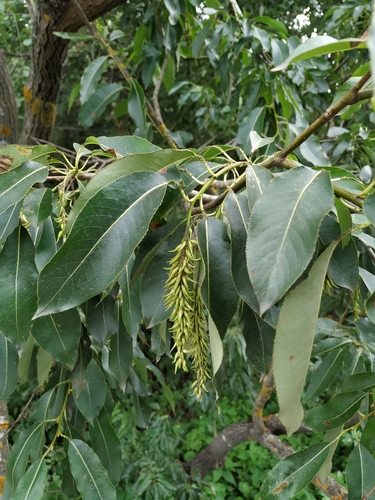
Laurel willow
Salix pentandra
With its shimmering, wax-like foliage and late-blooming golden catkins, the Laurel willow is a standout beauty of the wetlands. It bridges the gap between wild riparian zones and elegant backyard landscapes, serving as a vital sanctuary for pollinators and birds.
Quick Identification
Size
Typically reaches heights of 5–15 meters (16–50 feet) with a canopy spread of 8–12 meters (26–40 feet).
Colors
Glossy, dark emerald green upper leaves; pale, duller green undersides; yellowish-green catkins; grey-brown fissured bark.
Key Features
- Extremely glossy, leathery leaves resembling bay laurel
- Male catkins feature exactly five stamens per flower
- Late-season yellow blooms appearing after leaves emerge
- Finely serrated leaf margins with small resinous glands.
When You’ll See Them
Geographic range
Where Does the Laurel willow Live?
Native to the cool temperate regions of northern Europe and northern Asia, the Laurel willow thrives across a broad belt stretching from the British Isles and Scandinavia through Siberia. In North America, it has been widely introduced as an ornamental landscape tree and has successfully naturalized in several northern U.S. states and across various Canadian provinces. It is most frequently found in damp, low-lying areas where water is abundant.
Basemap © OpenStreetMap contributors
Behavior
The Laurel willow is a hardy, deciduous tree known for its exceptional vigor and ornamental beauty. Unlike many willow species that bloom in early spring on bare branches, this species is a late-bloomer, producing its vibrant yellow catkins in late May or June only after the foliage has fully unfurled. This timing makes it a critical late-season nectar source for pollinators such as bees and hoverflies.
As a member of the Salicaceae family, it exhibits a 'pioneer' growth habit, quickly colonizing damp areas and riverbanks. It is remarkably wind-resistant and cold-tolerant, often maintaining its striking glossy foliage well into the autumn months when other willows have already begun to drop their leaves. In suburban settings, it is often favored for its decorative qualities and its ability to act as a natural screen or windbreak.
EverydayEarth exclusive
Camera Tips
To capture the best images of a Laurel willow, focus on its unique glossy texture. Position your camera to take advantage of 'golden hour' light (early morning or late afternoon), which will make the waxy surface of the leaves shimmer and create high-contrast highlights that distinguish it from matte-leaved trees. If your camera has a macro setting, aim for the catkins in early summer to see the five distinct stamens that give the species its scientific name, pentandra.
Because this tree is a magnet for wildlife, it is a perfect anchor for a backyard trail camera. Place the camera at a height of 4-6 feet, angled slightly downward toward a branch or the base of the trunk. This will help you document the variety of insects attracted to the late-season nectar, as well as the songbirds that frequent the dense canopy for cover and foraging. Use a fast shutter speed or high-frame-rate video to catch the rapid movement of pollinators.
For a long-term project, set up a time-lapse over several months. The Laurel willow undergoes a dramatic transformation from its bright yellow late-spring catkins to its deep, leathery green summer phase, followed by a golden-yellow autumnal transition. Ensure your camera is securely mounted to a stationary post rather than a moving branch to prevent motion blur during high winds, as willows are known for their flexibility.
Similar Species
Species that look similar or are commonly confused with Laurel willow.
Shining Willow
Has more elongated, 'caudate' leaf tips and fewer stamens (usually 3) compared to the Laurel willow.
Crack Willow
Leaves are much less glossy and the twigs snap very easily with a distinctive 'crack' sound.
Bay Laurel
An evergreen shrub with aromatic leaves used in cooking; it is not a member of the willow family.
Frequently Asked Questions
Record Laurel willow at your habitat
Connect a camera to start building your own species record — AI identifies every visitor automatically.