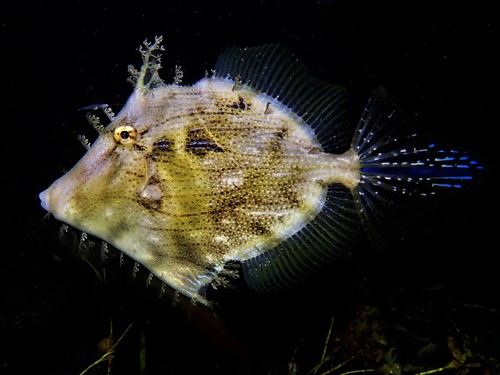
Leafy Filefish
Chaetodermis penicilligerus
The ultimate master of marine disguise, the Leafy Filefish uses elaborate skin tassels and a swaying motion to transform into a living piece of seaweed.
Quick Identification
Size
25–31 cm (10–12 inches) in length; typically weighs 0.5–0.9 kg (1.1–2.0 lbs)
Colors
Mottled tan, olive-green, and brown base with intricate dark wavy horizontal lines and small black spots; skin tassels match surrounding algae
Key Features
- Frayed, weed-like skin appendages (tassels) across the body
- Highly compressed, diamond-shaped profile
- Retractable large first dorsal spine above the eyes
- Tiny, terminal mouth with sharp, protruding teeth
- Large, fan-shaped tail fin used for steering
When You’ll See Them
Geographic range
Where Does the Leafy Filefish Live?
The Leafy Filefish is native to the tropical and subtropical waters of the Indo-West Pacific. Its primary range spans from the northern and western coasts of Australia through the Indonesian archipelago and the Philippines, reaching as far north as the coastal waters of southern Japan. It is most commonly found in sheltered coastal areas where marine vegetation is abundant.
Basemap © OpenStreetMap contributors
Behavior
The Leafy Filefish is one of nature's finest examples of crypsis, or the art of blending in. It spends the majority of its day hovering nearly motionless or drifting slowly among seagrass and algae. By aligning its thin, flat body with the direction of the current and swaying slightly, it perfectly mimics a piece of detached seaweed, allowing it to hide from predators and sneak up on unsuspecting prey.
Unlike many other reef-dwelling species that are highly territorial or social, the Leafy Filefish is generally solitary and somewhat shy. When threatened, it doesn't typically flee at high speeds; instead, it retreats into thick vegetation or uses its sharp dorsal spine to wedge itself into a crevice. In areas with human activity, such as docks or popular snorkeling spots, they can become somewhat curious, though they usually maintain a safe distance by keeping their narrowest profile facing the observer.
EverydayEarth exclusive
Camera Tips
To capture the Leafy Filefish on an underwater trail camera, location is everything. Look for 'transitional zones'—places where a sandy bottom meets a seagrass meadow or near the base of pier pilings that are heavily encrusted with growth. These fish love to hover near structures that offer camouflage, so mounting your camera to a weighted base near these features is much more effective than placing it in open water.
Because the Leafy Filefish relies on its tassels to blend in, you need high-resolution settings to distinguish the fish from the surrounding weeds. Set your camera to record in at least 2.7K or 4K if possible. Since they move slowly and deliberately, use a longer trigger interval and a video length of 20-30 seconds. This will give you enough footage to see the fish move, which is often the only way to spot it against a complex background.
If you are setting up a camera in a 'backyard' marine setting like a private dock, you can attract this species using a mesh bait bag filled with crushed mollusks or shrimp. Secure the bait bag about two feet in front of the lens. The scent will draw the filefish out of the seagrass. For the best color, aim for midday when the sun is directly overhead to penetrate the water; otherwise, use a red filter on your lens to counteract the blue-green color cast of the ocean.
Similar Species
Species that look similar or are commonly confused with Leafy Filefish.
Frequently Asked Questions
Record Leafy Filefish at your habitat
Connect a camera to start building your own species record — AI identifies every visitor automatically.