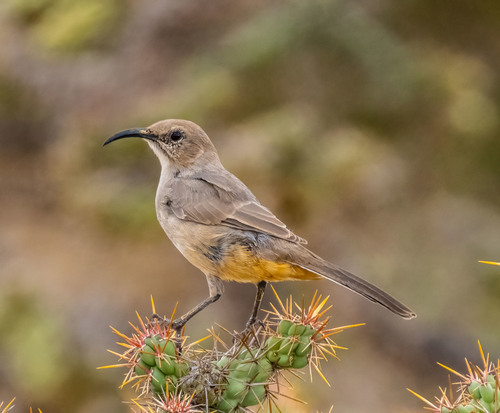
LeConte's Thrasher
Toxostoma lecontei
Meet the 'Ghost of the Desert,' a master of camouflage that thrives in the harshest heat of the American Southwest. This elusive runner is a prize for any backyard birder or trail camera enthusiast.
Quick Identification
Size
Length: 25–28 cm (10–11 in); Wingspan: 30–35 cm (12–14 in); Weight: 55–75 g (1.9–2.6 oz)
Colors
Pale sandy-gray or buff overall; darker brownish-black tail; dark eyes; faint dark 'mustache' stripe. Sexes are identical in appearance.
Key Features
- Long, deeply decurved black bill
- Pale sandy plumage matching desert soils
- Dark eye contrasting with a light face
- Long tail frequently held upward at a steep angle
When You’ll See Them
Geographic range
Where Does the LeConte's Thrasher Live?
Native to North America, the LeConte's Thrasher is a specialist of the hottest, driest corners of the Desert Southwest. Its core range spans the Mojave and Sonoran Deserts, stretching from southeastern California and southern Nevada into Arizona and down through the Baja Peninsula and Sonora in Mexico. They are non-migratory residents, famously staying put even in the most extreme summer heat of the Coachella Valley and Death Valley regions.
Basemap © OpenStreetMap contributors
Behavior
LeConte’s Thrashers are the ultimate desert specialists, often referred to by birders as 'ghosts of the desert' because of how perfectly they blend into the shimmering heat and sandy flats. Unlike many songbirds that flit through the canopy, these thrashers spend the vast majority of their time on the ground. They are incredible runners, preferring to sprint between desert shrubs like creosote or saltbush rather than taking flight when they feel threatened.
They are socially monogamous and highly territorial, remaining on the same patch of desert year-round regardless of the extreme temperatures. While they are famously shy around humans, they are known for their beautiful, complex songs which can be heard echoing across the flats during the cool morning hours of late winter. Despite their elusive nature, they are meticulous foragers, systematically patrolling their territory for any sign of movement in the sand or leaf litter.
EverydayEarth exclusive
Camera Tips
To capture high-quality footage of a LeConte's Thrasher, you must think like a ground-dweller. Position your camera very low—no more than 6 to 12 inches off the ground—and aim it horizontally across a clear patch of sandy soil between large shrubs. These birds prefer 'corridors' of open sand where they can run freely. Placing the camera on a small tripod or even a weighted base on the ground will give you that intimate, eye-level perspective that makes for stunning wildlife photography.
In the arid regions where these thrashers live, water is the ultimate lure. If you are on private land, a low-profile birdbath or even a slow-dripping water source can become a magnet for this species. Because they are shy, place the water near the cover of a saltbush so they feel safe approaching. Avoid using loud or bright trail cameras; a model with 'no-glow' infrared flash is essential for dawn or dusk activity, as these birds are extremely sensitive to visible light or mechanical noises.
Patience is key with this species. They are most active during the early morning hours before the desert heat peaks, usually between 5:00 AM and 9:00 AM. Set your camera to take short video bursts (10-15 seconds) rather than still photos. This allows you to capture their unique foraging behavior—using their curved bills like a scythe to toss aside desert pavement—which is far more engaging than a static image of a bird that is naturally camouflaged against the sand.
Similar Species
Species that look similar or are commonly confused with LeConte's Thrasher.
California Thrasher
Much darker, chocolate-brown plumage and prefers coastal sage scrub and chaparral rather than open desert.
Curve-billed Thrasher
Has a distinctively spotted breast and orange-yellow eyes, whereas the LeConte's has a plain breast and dark eyes.
Sage Thrasher
Smaller with a much shorter, straighter bill and heavy streaking on the underparts.
Frequently Asked Questions
Record LeConte's Thrasher at your habitat
Connect a camera to start building your own species record — AI identifies every visitor automatically.