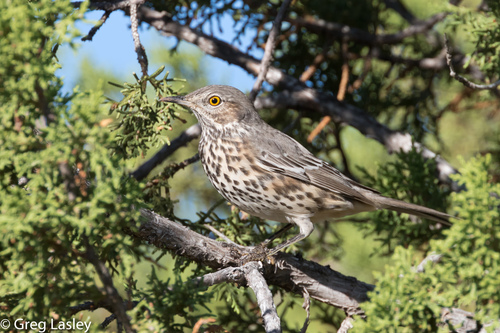
Sage Thrasher
Oreoscoptes montanus
The Sage Thrasher is the master of the western shrubsteppe, known for its brilliant yellow eyes and a song that can fill an entire canyon. Though it is the smallest of the thrashers, its presence is a vital sign of a healthy desert ecosystem.
Quick Identification
Size
Length: 20-23 cm (8-9 in); Wingspan: 30-33 cm (12-13 in); Weight: 40-50 g (1.4-1.8 oz)
Colors
Gray-brown upperparts with a pale, heavily streaked breast and belly. Adults feature striking bright yellow eyes and white tips on the outer tail feathers.
Key Features
- Distinctive bright yellow eyes
- Heavy dark brown teardrop-shaped streaking on a white breast
- Relatively short and straight black bill
- White corners on the tail visible during flight
When You’ll See Them
Behavior
The Sage Thrasher is often called the 'Voice of the Desert' due to its incredibly complex and melodious song. Unlike many other thrashers that prefer dense thickets, this species is a specialist of the open sagebrush plains. They are primarily ground-dwellers, often seen running across the desert floor with a characteristic tail-up posture rather than taking flight when disturbed. When they do fly, they stay low to the ground, moving between shrubs with a direct, fluttering flight pattern.
During the breeding season, males are conspicuous as they sing from the topmost branches of sagebrush to defend their territory. However, they are remarkably secretive when nesting, often disappearing into the shadows of a bush at the slightest hint of danger. They are generally solitary or found in pairs, but they can gather in loose, quiet flocks during the fall migration as they move toward the southwestern United States and Mexico.
EverydayEarth exclusive
Camera Tips
To capture high-quality footage of a Sage Thrasher, camera placement is everything. Since these birds spend the majority of their time on the ground or within the lower canopy of shrubs, you should mount your camera very low—ideally between 12 and 18 inches off the ground. Aim the lens at a small clearing between sagebrush plants or near the base of a large, mature bush where the ground is relatively clear. These 'corridors' are the bird's preferred highways for running between cover.
In the arid environments where these birds live, water is a powerful lure. If you have a ground-level birdbath or a leaking irrigation head, point your camera there. Sage Thrashers are known to visit water sources in the heat of the afternoon. Use a fast trigger speed setting; these birds are quick and twitchy, and a slow camera will often result in a 'ghost' or a tail-only shot. Video mode is particularly rewarding with this species, as it captures their unique habit of flicking their wings and bobbing their tails while foraging.
During the spring breeding season, look for a 'singing post'—usually the tallest sagebrush in the immediate area. If you can safely mount a camera to a nearby post or tripod aimed at the top of that shrub, you have a high chance of capturing the male's elaborate singing displays. For the best lighting in the high desert, ensure your camera is facing north or south to avoid the harsh glare of the rising or setting sun, which can wash out the subtle streaking on the bird's breast.
Similar Species
Species that look similar or are commonly confused with Sage Thrasher.
Northern Mockingbird
Lacks the heavy breast streaking and has much larger white patches on the wings and tail.
Curve-billed Thrasher
Larger with a much longer, more downward-curved bill and orange-red eyes rather than yellow.
Sagebrush Sparrow
Much smaller with a darker face and a single dark spot in the center of the breast rather than heavy streaking.
Frequently Asked Questions
Record Sage Thrasher at your habitat
Connect a camera to start building your own species record — AI identifies every visitor automatically.