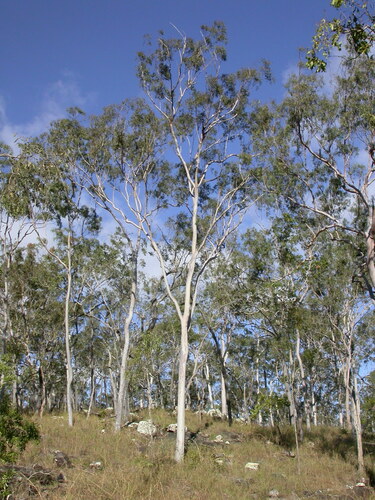
Lemon-scented gum
Corymbia citriodora
A towering icon of the Australian landscape, the Lemon-scented gum is famous for its luminous white bark and refreshing citrus fragrance. It stands as a vibrant hub for pollinators, offering a year-round spectacle of color and life.
Quick Identification
Size
Height 25–50 m (82–164 ft); Trunk diameter up to 1.2 m (4 ft)
Colors
Smooth bark in shades of white, cream, and pale pink; narrow grey-green to dark green leaves
Key Features
- Strong, distinct lemon aroma when leaves are crushed
- Uniformly smooth, powdery bark shed in thin curly flakes
- Clusters of three white flowers
- Large, woody urn-shaped fruit (gumnuts)
When You’ll See Them
Geographic range
Where Does the Lemon-scented gum Live?
Native to the tropical and subtropical regions of north-eastern Australia, the Lemon-scented gum is most at home in the coastal and sub-coastal ranges of Queensland. It has since been widely naturalized across other parts of Australia, particularly in New South Wales and Western Australia, where it thrives in well-drained soils. Beyond its native shores, this adaptable species has been introduced to similar climates worldwide, including California in the United States, South Africa, and various Mediterranean countries, where it is prized for both its timber and aromatic oils.
Basemap © OpenStreetMap contributors
Behavior
The Lemon-scented gum is a fast-growing, elegant evergreen known for its remarkably straight trunk and high, open canopy. One of its most distinctive behaviors is its annual bark-shedding process. The tree peels away its old, weathered outer layers in thin, papery flakes to reveal a fresh, luminous surface that can range from a brilliant white to a soft, coppery pink. This shedding isn't just for show; it helps the tree rid itself of potential parasites and epiphytes that might cling to its surface.
In the wild and in backyard settings, this species acts as a massive biological clock, signaling the seasons through its heavy flowering and seed dispersal. While it is a beloved ornamental tree due to its fragrance and aesthetic, it is also known for "summer branch drop," a unique physiological response where it may shed a heavy limb during extreme heat or drought to conserve its internal water pressure. In a garden ecosystem, it serves as a primary hub for social interaction among nectar-feeding birds and nocturnal mammals.
EverydayEarth exclusive
Camera Tips
To capture the full majesty of a Lemon-scented gum, place your camera at a significant distance—at least 20 feet—from the base of the trunk. Use a wide-angle lens and mount the camera at a height of 4–5 feet, angled slightly upward. This captures the dramatic transition from the stark white trunk to the delicate green canopy. Because the white bark is highly reflective, avoid using a strong flash at night, as it will likely result in a "white-out" image; instead, rely on ambient moonlight or long-exposure settings.
For those interested in the wildlife that visits the tree, the best strategy is to aim your camera at a specific limb or a cluster of lower blossoms during the winter and spring flowering months. These flowers are a magnet for honeyeaters, lorikeets, and flying foxes. Set your camera to a high-speed trigger or burst mode to catch the fast movements of these pollinators as they move between the white flower clusters. Positioning the camera to face east or west can help you catch the "golden hour" light, which turns the white bark into a stunning glowing pink.
Don't forget the ground level! During the bark-shedding season, the base of the tree becomes a hub of activity for insects and small reptiles hiding under the fallen flakes. A macro-capable camera placed near the roots can capture fascinating footage of the micro-ecosystem that thrives in the leaf litter and bark piles. If you are using a trail camera with time-lapse capabilities, set it to one photo every 30 minutes over several days to document the dramatic way the bark curls and peels away from the trunk.
Similar Species
Species that look similar or are commonly confused with Lemon-scented gum.
Frequently Asked Questions
Record Lemon-scented gum at your habitat
Connect a camera to start building your own species record — AI identifies every visitor automatically.