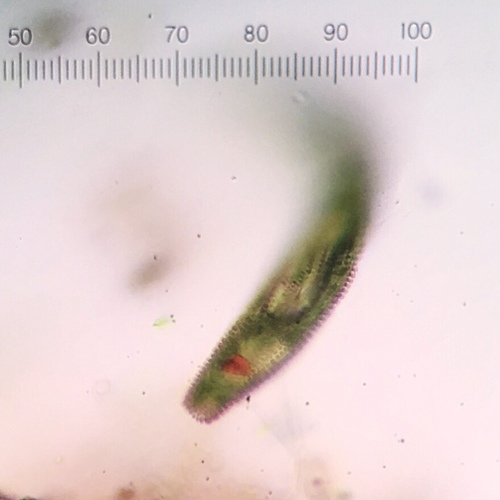
Lepocinclis spirogyroides
Lepocinclis spirogyroides
Discover the hidden geometry of the microworld! Lepocinclis spirogyroides is a stunning, spiral-shaped single-celled organism that turns your backyard pond into a microscopic jungle.
Quick Identification
Size
60-100 micrometers (0.002-0.004 inches) in length; 15-25 micrometers wide
Colors
Bright green internal chloroplasts with a brownish, translucent, or golden-hued outer membrane (pellicle)
Key Features
- Spirally twisted, spindle-shaped body
- Rigid pellicle covered in rows of small warts or granules
- Long, straight posterior spine
- Two large, ring-shaped paramylon (starch) grains
When You’ll See Them
Geographic range
Where Does the Lepocinclis spirogyroides Live?
Native to nearly every continent on Earth, this cosmopolitan micro-organism thrives wherever freshwater is found. From the garden ponds of North America and Europe to the tropical ditches of Southeast Asia and the wetlands of South America, it is a truly global resident. Because it can survive in various water conditions, you are just as likely to find it in a pristine lake as you are in a nutrient-rich backyard puddle.
Basemap © OpenStreetMap contributors
Behavior
Lepocinclis spirogyroides is a fascinating single-celled flagellate that acts as a bridge between the plant and animal worlds. As a member of the Euglenid group, it primarily gains energy through photosynthesis using its many discoid chloroplasts, yet it is also capable of absorbing organic nutrients from the surrounding water. Unlike some of its cousins that change shape rapidly, this species has a very rigid outer layer, meaning it maintains its distinctive spiral shape even as it moves.
In its aquatic environment, it uses a single long flagellum (a whip-like tail) to pull itself through the water column. While it doesn't 'socialize' in the traditional sense, it is often found in dense populations alongside other micro-fauna in nutrient-rich water. It exhibits phototaxis, meaning it will actively swim toward light sources to optimize its photosynthetic activity, though it avoids light that is too intense.
EverydayEarth exclusive
Camera Tips
Capturing Lepocinclis spirogyroides requires a different approach than typical backyard wildlife. Since this species is microscopic, you won't find it with a standard trail camera. Instead, use an AI-powered digital microscope or a high-magnification macro lens attachment for your smartphone. For the best results, sample water from the 'benthic' zone—the bottom layer of a pond or birdbath—near decaying leaves, as this species prefers nutrient-rich sediment.
When setting up your micro-camera station, use 'Brightfield' illumination, where light shines through the sample from below. This will highlight the intricate spiral warts on the pellicle and the vibrant green chloroplasts inside. If your camera has a video mode, use it; the spiral-swimming motion of Lepocinclis is its most distinctive identification feature and is easier for AI software to recognize than a still image.
To get a clear shot, use a 'depression slide' or a standard slide with a cover slip. If the organism is moving too fast for your camera's shutter speed, you can add a drop of 'slowing solution' (like methylcellulose) to the water sample. This thickens the liquid and allows you to capture the fine details of the posterior spine and the two large paramylon grains located inside the cell.
Seasonality plays a big role in micro-wildlife photography. While Lepocinclis is present year-round, you will see a massive spike in activity during the 'Spring Bloom' when water temperatures rise above 15°C (60°F). During this time, the concentration of these organisms increases, making it much easier to find and record high-quality footage for your EverydayEarth collection.
Similar Species
Species that look similar or are commonly confused with Lepocinclis spirogyroides.
Frequently Asked Questions
Record Lepocinclis spirogyroides at your habitat
Connect a camera to start building your own species record — AI identifies every visitor automatically.