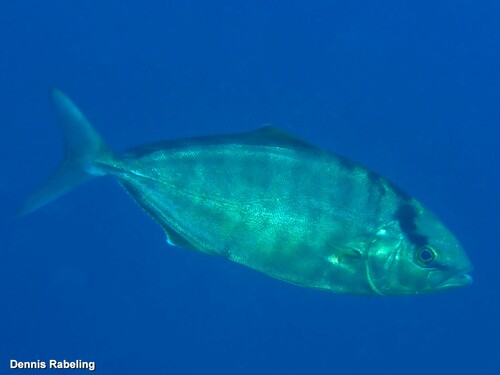
Lesser Amberjack
Seriola fasciata
The Lesser Amberjack is a hidden gem of the deep Atlantic, a streamlined hunter that thrives among the shadows of ancient shipwrecks and coral ledges. While smaller than its famous cousins, it is a master of the deep continental shelf, distinguished by its striking dark eye-stripe and silver agility.
Quick Identification
Size
Typically 30-45 cm (12-18 inches) in length; maximum length up to 67.5 cm (26.6 inches). Weight usually ranges from 1-2.5 kg (2.2-5.5 lbs).
Colors
Olive-green or brownish back fading to silvery-white sides and belly; features a dark diagonal band running from the eye to the origin of the first dorsal fin.
Key Features
- Dark diagonal 'mask' stripe through the eye
- Deeper, more compressed body than other amberjacks
- Usually possesses 8 dorsal spines
- Pectoral fins shorter than the head length
When You’ll See Them
Geographic range
Where Does the Lesser Amberjack Live?
The Lesser Amberjack lives across the vast temperate and tropical stretches of the Atlantic Ocean. In the Western Atlantic, its range spans from the coast of Massachusetts in the United States, through the Gulf of Mexico and the Caribbean, and as far south as Brazil. In the Eastern Atlantic, this species is commonly found around the Mediterranean Sea and the island chains of Madeira and the Canary Islands, favoring the deep continental shelves of these regions.
Basemap © OpenStreetMap contributors
Behavior
The Lesser Amberjack is a sleek, predatory fish that primarily inhabits the deeper waters of the continental shelf. Unlike its larger relative, the Greater Amberjack, which often roams the entire water column, this species is more demersal, meaning it prefers to stay near the seafloor. They are frequently found hovering around rocky reefs, shipwrecks, and debris, where they use their streamlined bodies to navigate currents and surprise prey.
While they can be found in small schools, older individuals tend to be more solitary. They are known for their curiosity and will often approach underwater structures or divers, though they are generally more elusive than other members of the Carangidae family. In their social interactions, they exhibit typical schooling behavior when young, often associating with floating objects or larger marine life for protection.
EverydayEarth exclusive
Camera Tips
To capture the Lesser Amberjack on camera, you will need specialized equipment capable of handling significant depths. Since this species typically stays between 50 and 130 meters deep, a waterproof drop-camera or a remote-operated vehicle (ROV) is required. Focus your efforts on deep-water structures; artificial reefs, sunken vessels, and natural limestone ledges are the best places to set up a stationary camera rig. These structures act as 'oases' in the sandy plains of the continental shelf where Lesser Amberjacks love to hunt.
Using a scent-based lure is highly effective for this species. A perforated PVC tube filled with crushed mackerel or menhaden (chum) tied near the camera's field of view will attract them from down-current. Because sunlight is heavily filtered at these depths, high-output LED arrays are essential. Try to position your lights at a 45-degree angle away from the lens to minimize 'backscatter' from suspended particles in the water, which can trick AI detection systems.
Set your camera to record at a high frame rate, at least 60 frames per second. Lesser Amberjacks are fast-striking predators, and their movements can appear blurred on standard 24fps or 30fps settings. If your AI system allows for specific trigger zones, focus the trigger on the area around the bait bag. Because they often cruise just above the seafloor, keep the camera lens aimed slightly upward from the bottom to capture their distinct silhouette against the lighter water above.
Similar Species
Species that look similar or are commonly confused with Lesser Amberjack.
Greater Amberjack
Much larger (up to 1.8m) with a more elongated body and typically only 7 spines in the first dorsal fin.
Almaco Jack
Has a much higher, more sickle-shaped second dorsal fin and a darker, more olive-toned body.
Banded Rudderfish
Smaller and more slender; juveniles have very distinct vertical dark bars that fade as they age.
Frequently Asked Questions
Record Lesser Amberjack at your habitat
Connect a camera to start building your own species record — AI identifies every visitor automatically.