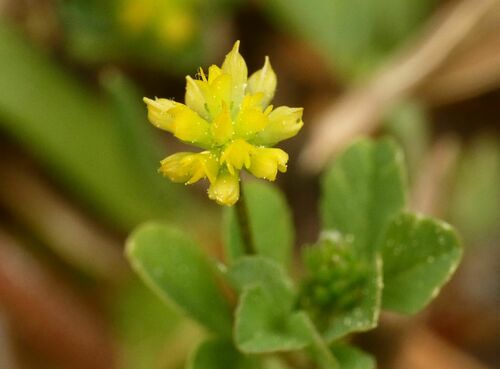
Lesser hop trefoil
Trifolium dubium
Often celebrated as the original 'Shamrock' of Ireland, the Lesser hop trefoil is a tiny but mighty inhabitant of your lawn. Its miniature yellow blooms provide a critical nectar station for the smallest of our backyard pollinators.
Quick Identification
Size
Height 5-25 cm (2-10 inches); flower heads 3-9 mm (0.1-0.35 inches) wide
Colors
Bright yellow flower heads that turn papery brown with age; emerald to olive green foliage
Key Features
- Small globe-shaped yellow flower heads with 3-20 individual florets
- Trifoliate leaves where the central leaflet sits on a short distinct stalk
- Thin, wiry reddish stems that often sprawl along the ground
- Flowers turn brown and droop downwards once they are pollinated
When You’ll See Them
Behavior
The Lesser hop trefoil is a resilient annual plant that follows a strategy of subtle persistence. It is a nitrogen-fixer, meaning it hosts specialized bacteria in its root nodules that convert atmospheric nitrogen into a form the plant can use for food. This allows it to thrive in nutrient-poor soils where other garden plants might wither, making it a common pioneer species in disturbed ground and dry lawns.
Despite its delicate appearance, this species is highly adapted to human environments. Its low-growing, prostrate habit allows it to survive frequent lawn mowing, as the flowers often sit just below the height of standard mower blades. It serves as a vital early-season nectar source for small-bodied pollinators, such as solitary bees and hoverflies, which are often the only insects small enough to navigate its tiny florets.
EverydayEarth exclusive
Camera Tips
To capture the Lesser hop trefoil effectively, you need to think like a macro photographer. Because this plant rarely grows taller than a few inches, your camera should be mounted as close to the ground as possible. Use a 'ground pod' or a small flexible tripod to get the lens within 6-12 inches of the flower heads. A 45-degree downward angle is ideal, as it allows the camera to capture the distinctive clover-like leaves and the yellow 'hop' flower head in a single frame.
Lighting is the most critical factor for this species. Bright, direct midday sun can wash out the delicate yellow of the petals and create harsh shadows. For the best results, set your camera to capture images during the 'golden hour'—the hour after sunrise or before sunset. The soft, warm light will accentuate the texture of the leaves and the individual florets. If you are using a trail camera with a 'macro' or 'close-focus' setting, ensure it is engaged to avoid blurry images at such short distances.
Since this plant is a magnet for tiny pollinators, try setting your camera to a 'burst' or 'high-speed' photo mode. This increases your chances of catching a solitary bee or a small butterfly in the middle of a visit. Even a slight breeze can cause significant motion blur when shooting at close range, so choose a calm day or use a fast shutter speed (1/500s or faster) if your camera settings allow for manual override.
Don't stop recording once the flowers start to fade. One of the most interesting aspects of the Lesser hop trefoil is its transition from bright yellow to a light, papery brown. This 'hop-like' appearance is where it gets its name. Capturing a time-lapse over several weeks from the same position can provide a fascinating look at its life cycle, from the first yellow bud to the brown, seed-heavy pods that will ensure next year's growth.
Similar Species
Species that look similar or are commonly confused with Lesser hop trefoil.
Frequently Asked Questions
Record Lesser hop trefoil at your habitat
Connect a camera to start building your own species record — AI identifies every visitor automatically.