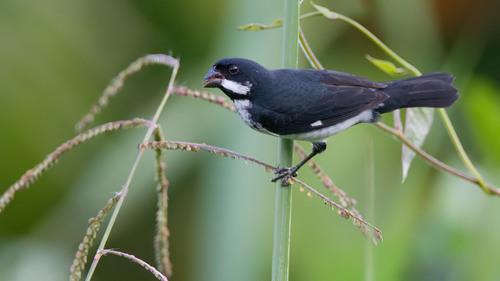
Lesson's Seedeater
Sporophila bouvronides
A dapper little songbird of the South American grasslands, the Lesson's Seedeater is a master of the 'weed-patch' stage. With its striking black-and-white mask and melodic voice, it's a favorite for backyard observers in tropical regions.
Quick Identification
Size
10.5–11.5 cm (4.1–4.5 in) long; weights 8–11 g (0.28–0.39 oz)
Colors
Males have a black crown, back, and wings with a distinctive white moustachial streak and white underparts. Females are olive-brown or buffy-brown overall.
Key Features
- Solid black crown on males (no white stripe)
- Bold white moustachial streak
- Small, stubby conical black bill
- White wing speculum visible in flight
When You’ll See Them
Geographic range
Where Does the Lesson's Seedeater Live?
Lesson's Seedeater is a South American native, primarily found across the northern half of the continent. Its core range stretches from Colombia and Venezuela through the Guianas and into northern Brazil and eastern Peru, including the islands of Trinidad and Tobago. These birds are notable intra-tropical migrants, shifting their populations based on seasonal rainfall and seed availability across the Amazon basin and northern territories.
Basemap © OpenStreetMap contributors
Behavior
These birds are intra-tropical migrants, meaning they move significant distances within South America following the seasonal rains that trigger grass growth. While they can be somewhat flighty, they are adaptable and have learned to take advantage of human-altered landscapes, often appearing in suburban gardens and agricultural edges where 'weedy' patches are left undisturbed.
EverydayEarth exclusive
Camera Tips
To capture the Lesson's Seedeater on camera, focus your efforts on 'wild' corners of your property. Unlike many backyard birds that prefer traditional feeders, these seedeaters are specifically drawn to standing tall grass. Position your camera about 3 feet off the ground, angled toward a patch of seeding guinea grass or similar native grasses. They are most likely to visit when the seeds are ripe but still attached to the plant.
Timing is a critical factor for this species. They are most active in the early morning hours just after sunrise when they descend to feed while the air is still cool. Set your camera’s trigger sensitivity to high; these are small, rapid-moving birds that rarely sit still for long. Because they are migratory, you will have the best results during the local rainy season when grass seeds are most abundant.
For the best visual results, place your camera with the sun behind it to highlight the stark contrast of the male's black and white plumage. Avoid placing cameras in areas with heavy overhead foliage that creates distracting shadows. If you have a shallow, ground-level birdbath, this can be an excellent secondary location, as seedeaters need to hydrate frequently after eating dry seeds.
Similar Species
Species that look similar or are commonly confused with Lesson's Seedeater.
Frequently Asked Questions
Record Lesson's Seedeater at your habitat
Connect a camera to start building your own species record — AI identifies every visitor automatically.