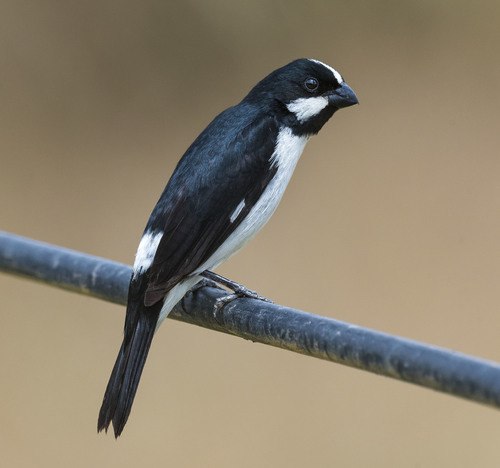
Lined Seedeater
Sporophila lineola
With its dapper 'mustache' and melodic trill, the Lined Seedeater is a charismatic visitor to South American grasslands and gardens. This tiny traveler follows the rains across the continent, bringing life and song to open spaces wherever grass seeds are plenty.
Quick Identification
Size
10–11 cm (4–4.3 in) long; wingspan 15–18 cm (6–7 in); weight 7.5–12 g (0.26–0.42 oz)
Colors
Males are glossy black above with a white belly, white crown stripe, and white mustache; females are overall olive-brown.
Key Features
- Bold white stripe on the center of the crown (males)
- White malar 'mustache' stripes
- Small, stubby black conical bill
- Uniformly olive-brown plumage (females)
- Glossy black upperparts (males)
When You’ll See Them
Geographic range
Where Does the Lined Seedeater Live?
This resilient little traveler is native to the South American continent, boasting a vast and complex range that shifts with the seasons. It is most commonly found throughout Brazil, where it breeds extensively, as well as in neighboring Argentina, Paraguay, and Bolivia. During the austral winter, many populations migrate north towards Venezuela, Colombia, and the Guyanas, making them a true intra-tropical migrant of the Neotropics.
Basemap © OpenStreetMap contributors
Behavior
The Lined Seedeater is a social and vocal little bird, often found in small flocks alongside other seedeater species. They are highly active during the morning hours, darting between tall grass stalks where they expertly cling to seed heads to forage. Their song is a series of sweet, hurried trills that males use to defend small territories during the breeding season.
These birds are known for their seasonal movements, often appearing in large numbers when grass seeds are abundant and then vanishing once the food source is depleted. While they can be wary of humans, they frequently visit suburban gardens and rural agricultural areas, provided there is enough cover and a steady supply of their favorite grasses.
EverydayEarth exclusive
Camera Tips
To capture the Lined Seedeater on your backyard camera, focus on their preferred foraging height. Since they are grass-dwelling specialists, place your camera approximately 1 to 2 feet (30-60 cm) off the ground, angled slightly upward or parallel to the tops of tall seeding grasses. If you have a birdbath or a shallow water source, this is an excellent secondary location, as these birds need to drink and bathe frequently in tropical climates.
While they don't typically visit traditional hopper feeders for sunflower seeds, you can lure them by planting native grasses or leaving a 'wild' patch in your yard where grasses are allowed to go to seed. Alternatively, offering 'spray millet' (commonly sold for pet birds) near a low-profile feeding platform can be very effective. Set your camera to a fast trigger speed or burst mode, as these birds move quickly and may only land for a few seconds at a time.
The best time for clear shots is during the early morning hours, shortly after sunrise, when they are most active and vocal. Ensure your camera is positioned to take advantage of the low morning sun to highlight the male's glossy black feathers and white markings. In terms of settings, a high-resolution video mode with a 2-3 second pre-record function is ideal for catching the moment they fly into the frame from the undergrowth.
Similar Species
Species that look similar or are commonly confused with Lined Seedeater.
Frequently Asked Questions
Record Lined Seedeater at your habitat
Connect a camera to start building your own species record — AI identifies every visitor automatically.