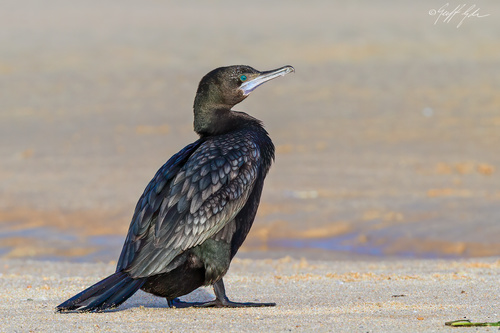
Little Black Cormorant
Phalacrocorax sulcirostris
A sleek, emerald-eyed master of the water, the Little Black Cormorant is famous for its coordinated pack-hunting and iconic wing-drying pose.
Quick Identification
Size
Length: 55–65 cm (21.5–25.5 in); Wingspan: 95–105 cm (37–41 in); Weight: 550–1200 g (1.2–2.6 lb)
Colors
Uniformly charcoal-black plumage with a subtle green or purple iridescence; lead-grey bill and striking emerald-green to blue-green eyes.
Key Features
- Entirely black plumage without white markings
- Slender, hook-tipped lead-grey bill
- Deep emerald-green eyes in adults
- Long, stiff tail often used as a rudder
When You’ll See Them
Geographic range
Where Does the Little Black Cormorant Live?
The Little Black Cormorant is a wide-ranging waterbird native to the Australasian and Indomalayan realms. It is most commonly found throughout the mainland of Australia and across both the North and South Islands of New Zealand, where it is often referred to as the Little Black Shag. Beyond these core regions, its reach extends northward through Indonesia, Papua New Guinea, and various Pacific islands, thriving anywhere with stable freshwater or coastal ecosystems.
Basemap © OpenStreetMap contributors
Behavior
The Little Black Cormorant is a highly social waterbird, distinguished by its unique habit of communal hunting. Unlike many other cormorants that forage solo, this species often forms large 'fishing fleets' that move in synchronized waves across the water, driving schools of small fish into shallows or toward the surface where they can be easily snatched.
Because their feathers are not fully waterproof, you will frequently observe them perched on logs, rocks, or branches with their wings spread wide to dry in the sun. They are generally quieter than other seabirds but can be quite vocal at their nesting colonies, producing deep grunting or hissing sounds. While they are wary of direct human contact, they have adapted well to urban environments and are common sights in city park ponds and suburban canals.
EverydayEarth exclusive
Camera Tips
To capture the best footage of a Little Black Cormorant, position your camera low to the ground near the water's edge, focusing on logs, pylons, or rocks that sit 30–60 cm above the water level. These are 'haul-out' spots where the birds go to dry their wings after a hunt. Since they are stationary during this process, it provides the perfect opportunity for your AI camera to trigger and record clear, high-detail video without the motion blur associated with flight.
While you cannot attract them with traditional birdseed, you can encourage them to visit your field of view by placing a sturdy, horizontal branch (a 'perch') over a backyard pond or shoreline. Aim your camera so the morning or afternoon sun is behind the lens. This is crucial for this species; their all-black feathers can look like a flat silhouette in harsh light, but the low-angle sun will reveal the beautiful emerald shimmer of their eyes and the iridescent greens and purples in their plumage.
Set your camera to a high-sensitivity trigger or use 'Burst Mode' if available. These birds are remarkably fast when diving and resurfacing, and they often appear unexpectedly from underwater. If you are near a large body of water, look for 'pack hunting' behavior during the middle of the day; setting your camera to a wide-angle view can help capture the scale of these social fishing groups rather than just a single individual.
Similar Species
Species that look similar or are commonly confused with Little Black Cormorant.
Frequently Asked Questions
Record Little Black Cormorant at your habitat
Connect a camera to start building your own species record — AI identifies every visitor automatically.