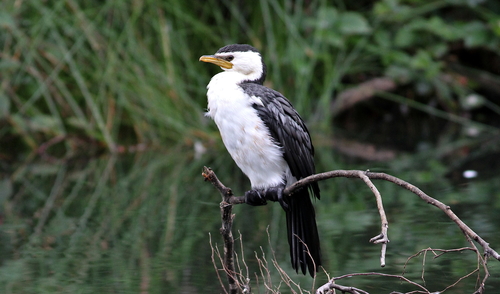
Little Pied Cormorant
Microcarbo melanoleucos
The Little Pied Cormorant is a charming, yellow-billed diver as comfortable in an urban garden as it is on a rugged coastline. Known for its iconic 'wing-drying' pose, this adaptable bird is a favorite for backyard birdwatchers and nature photographers alike.
Quick Identification
Size
Length: 56-65 cm (22-26 in); Wingspan: 80-95 cm (31-37 in); Weight: 400-900 g (0.9-2 lbs)
Colors
Glossy black upperparts and white underparts; yellow to pale orange short bill; dark grey to black legs
Key Features
- Smallest cormorant in its range
- Short, stubby yellow bill
- Small black crest on the forehead
- White face and throat extending down to the belly
When You’ll See Them
Geographic range
Where Does the Little Pied Cormorant Live?
The Little Pied Cormorant is native to the vast landscapes of Australasia and the Indo-Pacific, spanning a core range that includes the entirety of Australia, New Zealand, and New Guinea. Beyond these major landmasses, they are frequent residents of Indonesia, Timor-Leste, and the scattered islands of the south-western Pacific and subantarctic regions. While they are highly adaptable to various water sources, their highest population densities are found throughout the temperate and tropical coastal zones of the Australian mainland and both the North and South Islands of New Zealand.
Basemap © OpenStreetMap contributors
Behavior
The Little Pied Cormorant is a solitary and highly capable hunter, often seen perched alone on a branch or rock overhanging the water. Unlike many other waterbirds, their feathers are not fully waterproof. While this reduced buoyancy allows them to dive deeper and stay underwater longer to chase prey, it also means they get waterlogged. You will frequently see them standing with their wings spread wide in a 'heraldic' pose, using the sun and wind to dry their plumage before their next flight.
While they are less social than their larger cousins during the day, they often gather in communal roosts at night or during the breeding season. They are remarkably bold and have adapted exceptionally well to human-modified environments. It is not uncommon to find them visiting suburban backyard fish ponds or urban park lakes, where they quickly learn the best spots to snag a meal.
EverydayEarth exclusive
Camera Tips
Placement is the most critical factor for capturing high-quality footage of this species. Focus your camera on a 'drying perch'—usually a log, rock, or low branch that protrudes from or over-hangs the water. These birds are creatures of habit and will return to the same sunny spot to dry their wings after a hunting session. Set your camera height to be level with the perch to capture the most intimate, eye-level details of their plumage and bill.
Because the Little Pied Cormorant has high-contrast black and white feathers, lighting can be tricky. Avoid placing the camera where it will face the direct midday sun, as this often results in 'blown-out' white feathers and lost detail in the black sections. Early morning or late afternoon light provides a softer glow that highlights the glossy sheen of their back. If your camera allows for exposure adjustment, a slight underexposure can help preserve the detail in their white chest.
Use a high-speed trigger or video mode to capture their unique behaviors. The 'wing-drying' pose is spectacular on video, especially when they shake their tail or flick their wings to shed water. If you are setting up near a backyard pond, ensure the camera is close enough to trigger on a bird roughly the size of a crow; these aren't large birds, so a medium-range sensitivity setting is usually best.
While you should never use artificial bait to attract them, maintaining a healthy, chemical-free pond with natural vegetation and a few native fish or shrimp is the best natural lure. In the wild, look for 'whitewash' (white bird droppings) on lakeside structures—this is a surefire sign of a regular resting spot and the perfect place for a trail camera setup.
Similar Species
Species that look similar or are commonly confused with Little Pied Cormorant.
Little Black Cormorant
Entirely black plumage and a longer, slender grey bill, compared to the white front and yellow bill of the Little Pied.
Great Cormorant
Much larger (nearly double the size) with a heavier, grey-hooked bill and mostly black plumage with only a small white patch on the face.
Pied Cormorant
Larger than the Little Pied, with a longer bill and a distinct orange patch of skin in front of the eye.
Frequently Asked Questions
Record Little Pied Cormorant at your habitat
Connect a camera to start building your own species record — AI identifies every visitor automatically.