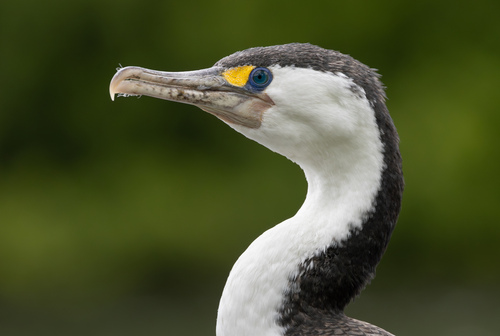
Pied Cormorant
Phalacrocorax varius
Striking monochrome plumage and a vibrant yellow face make the Pied Cormorant a coastal icon across Australasia. A master of the underwater hunt, this large bird is often seen drying its wings on prominent perches after a deep-sea dive.
Quick Identification
Size
Length 65-85 cm (26-33 in), wingspan 110-130 cm (43-51 in), weight 1.3-2.2 kg (2.9-4.9 lb)
Colors
Jet black upperparts and thighs, stark white underparts from chin to vent; yellow-orange facial skin in front of the eyes; green-blue eye ring; grey hooked bill.
Key Features
- Large yellow or orange patch between the eye and bill
- Clean white throat and underparts contrasting with black wings
- Large, sturdy grey bill with a sharp hook at the tip
- Black thighs that distinguish it from the smaller Little Pied Cormorant
When You’ll See Them
Geographic range
Where Does the Pied Cormorant Live?
Native to the Australasian region, the Pied Cormorant is a staple of the coastlines of Australia and New Zealand. While they are most abundant along the rocky shores and sandy estuaries of mainland Australia, they are also widely distributed across both the North and South Islands of New Zealand, where they are often referred to as the Pied Shag or Kāruhiruhi. Beyond the immediate coast, these birds follow major river systems deep into the interior, making them a common sight in the wetlands and large permanent lakes of the Murray-Darling Basin.
Basemap © OpenStreetMap contributors
Behavior
The Pied Cormorant is a highly social bird, often seen in large colonies during breeding season or in smaller groups while foraging. They are master divers, using their powerful webbed feet to propel themselves underwater in pursuit of prey. Because their feathers are not fully waterproof—a trait that helps them reduce buoyancy for deeper dives—they spend a significant portion of their day perched on rocks or branches with their wings spread wide to dry in the sun.
While they are primarily coastal, they are surprisingly adaptable and will move inland following river systems. In many suburban areas with large lakes or estuaries, they have become accustomed to human presence, often using boat ramps and jetties as convenient resting spots. However, they remain wary and will quickly take flight if approached too closely on foot.
EverydayEarth exclusive
Camera Tips
Location is everything when trying to capture a Pied Cormorant on a backyard or trail camera. Since these birds spend much of their time diving, the best place for a camera is near their 'drying stations.' Unlike many other waterbirds, cormorants have less preen oil, so their feathers become waterlogged. Look for exposed logs, jetty pylons, or low-hanging branches over the water where they stand with wings outstretched. Position your camera at a slight downward angle from a higher bank to capture the full wingspan during this behavior.
Setting the right trigger speed is crucial. Because these birds can transition from a stationary drying pose to a sudden dive or flight in a split second, use a camera with a trigger speed of 0.5 seconds or faster. If your AI camera supports 'Burst Mode' or 'Photo-to-Video,' enable it. Capturing a sequence of shots allows you to see the powerful take-off or the moment they emerge from the water with a fish in their bill.
Lighting and exposure can be tricky with high-contrast birds. The Pied Cormorant’s stark white chest and deep black back can cause 'blown-out' whites in bright midday sun. Aim your camera so the sun is at the camera's back, or set the exposure compensation slightly lower (-0.5 or -1.0) to preserve the detail in the white plumage. Early morning and late afternoon provide the softest, most flattering light for their vibrant facial colors.
Don't bother with traditional food baits, as these are active hunters who only strike at moving prey. Instead, 'lure' them by providing a stable, attractive perch if you have a private pond or waterfront. A sturdy branch secured at a 45-degree angle out of the water in a quiet area will naturally attract them as a safe place to rest and digest, creating a consistent 'studio' for your camera.
Similar Species
Species that look similar or are commonly confused with Pied Cormorant.
Little Pied Cormorant
Much smaller with a shorter, stubbier bill and lacks the yellow facial patch in front of the eye.
Great Cormorant
Larger and almost entirely black with only a small white patch on the throat/thighs during breeding.
Little Black Cormorant
Entirely black plumage and much more slender than the Pied Cormorant.
Frequently Asked Questions
Record Pied Cormorant at your habitat
Connect a camera to start building your own species record — AI identifies every visitor automatically.