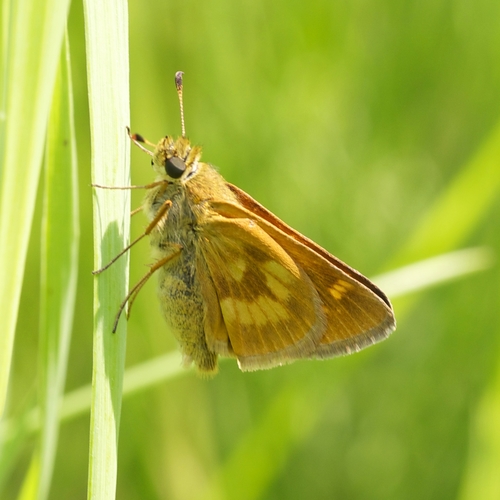
Long Dash
Limochores mystic
A vibrant summer visitor, the Long Dash skipper is a master of high-speed maneuvers and golden-orange hues. Look for this energetic butterfly darting through meadows and sun-soaked backyards throughout the northern United States and Canada.
Quick Identification
Size
Wingspan of 1.1 to 1.5 inches (28 to 38 mm)
Colors
Tawny-orange and dark brown; males feature a prominent long, black 'dash' (stigma) on the forewing, while females have a larger dark patch at the wing base.
Key Features
- Long, thin, curved black stigma on male forewings
- Underside of hindwing is orange-brown with a curved row of yellow spots
- Rapid, darting 'skipping' flight pattern
- Hooked clubs at the ends of the antennae
When You’ll See Them
Behavior
The Long Dash is a member of the 'skipper' family, named for their erratic and incredibly fast flight patterns. Unlike many larger, gliding butterflies, the Long Dash moves with a buzzing energy, darting from flower to flower. They are highly territorial; males are often seen perching on tall blades of grass or low shrubs, waiting for females to pass by and occasionally chasing away rival males or even larger insects that venture into their space.
These butterflies are primarily solitary but will congregate in high-quality habitats like damp meadows or gardens with abundant nectar. They spend much of their time 'basking' with their wings partially open to soak up the sun's warmth, which provides the energy needed for their high-speed maneuvers. While they are wary of sudden movements, they can be quite approachable when focused on feeding at a flower.
EverydayEarth exclusive
Camera Tips
To capture high-quality footage of the Long Dash, focus your camera on 'landing pads' rather than trying to track them in flight. Look for sun-drenched clusters of nectar-rich flowers like Purple Coneflower, Milkweed, or Butterfly Bush. Position your camera about 12 to 24 inches away from these blooms, ideally at a 45-degree downward angle to capture the intricate patterns on the top of their wings and the distinguishing 'dash' on the males.
Since these butterflies are small and move quickly, use a high-frame-rate setting if your camera supports it. This will allow you to see the unique way they hold their wings—the 'jet plane' posture where forewings are held upright while hindwings are spread flat. Because they are cold-blooded, they are most active when the sun is directly hitting your garden. Avoid placing cameras in deep shade, as the Long Dash will rarely visit those areas.
For the best results, place a flat, light-colored stone or a 'puddling' station (a shallow dish of damp sand and a pinch of sea salt) near your camera. Skippers often visit these spots to drink mineral-rich water. Setting your camera's AI to 'Small Animal' or 'Insect' mode will help reduce false triggers from wind-blown foliage while ensuring you don't miss these fast-moving visitors during their short summer flight window.
Similar Species
Species that look similar or are commonly confused with Long Dash.
Peck's Skipper
Smaller with a very bold, jagged yellow patch on the underside of the hindwing rather than the Long Dash's even band of spots.
Tawny-edged Skipper
Lacks the prominent yellow spots on the underside of the hindwing, appearing more uniform olive-brown underneath.
Crossline Skipper
Generally duller brown with a smaller, straighter stigma in males compared to the long, curved dash of Limochores mystic.
Frequently Asked Questions
Record Long Dash at your habitat
Connect a camera to start building your own species record — AI identifies every visitor automatically.