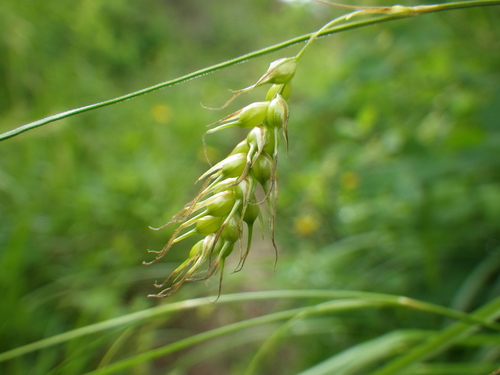
longbeak sedge
Carex sprengelii
An elegant, drooping sedge that adds movement and texture to the forest floor. Known for its distinctive long-beaked seeds, it provides vital early-season cover for backyard wildlife.
Quick Identification
Size
Stands 30–90 cm (12–36 inches) tall with a foliage spread of 30–60 cm (12–24 inches).
Colors
Bright lime-green foliage; straw-colored to tan seed heads; dark brown fibrous roots at the base.
Key Features
- Long, slender 'beaks' on the seed sacs (perigynia)
- Distinctive drooping or nodding seed spikes
- Persistent tufts of dark, hair-like fibers at the plant base
- Narrow, arching leaves that form dense clumps
When You’ll See Them
Behavior
While longbeak sedge doesn't move like the animals usually captured on trail cameras, it exhibits a fascinating seasonal lifecycle that defines the woodland floor. As a clump-forming perennial, it stays anchored in one spot but expands through short rhizomes, eventually creating lush, fountain-like mounds of greenery. In the early spring, it is one of the first plants to wake up, sending out bright green shoots while the surrounding forest is still grey.
Its most characteristic 'behavior' is the way it presents its seeds. By late spring, the plant produces long, pendulous stalks that sway gracefully in the slightest breeze. This movement isn't just for show; it helps the seeds catch the wind and attracts ground-foraging birds. In a garden setting, it plays a social role as a 'matrix plant,' providing essential structural support and cover for insects and small amphibians navigating the shade.
EverydayEarth exclusive
Camera Tips
To capture the best images of longbeak sedge and the wildlife it attracts, place your camera on a low-profile stake about 12–18 inches off the ground. Because this sedge produces nodding seed heads that dance in the wind, the movement can often trigger AI cameras. To avoid a memory card full of 'false positives' from wind, try to angle your camera so the sedge is in the mid-ground, using a nearby log or stone as a stable focal point for the AI to lock onto.
If you are interested in the 'visitors' this plant brings, position your lens to overlook the seed heads during June and July. Small songbirds like Sparrows and Finches are often caught on camera clinging to the drooping stems to feast on the long-beaked seeds. Set your camera to 'Burst Mode' or a short 10-second video clip to capture the fast-paced feeding action. Early morning light (6 AM – 9 AM) provides a soft glow that highlights the translucent quality of the seed sacs, making for much more professional-looking footage.
For those using cameras with time-lapse capabilities, longbeak sedge is an excellent subject for a 'Seasonal Growth' project. Set the camera to take one photo every 12 hours starting in early April. By June, you will have a stunning visual record of the 'fountain' effect as the leaves arch outward and the seed stalks emerge and drop. Make sure the camera is securely mounted to a tree or post to prevent shifting over several months.
Finally, consider the background. Because the foliage is a bright lime-green, placing your camera so it faces a darker, shaded area or a mulch bed will provide a high-contrast backdrop that makes the delicate texture of the sedge pop. If your camera has adjustable sensitivity, turn it down slightly on windy days, as the longbeak sedge is much more reactive to breezes than stiffer prairie grasses.
Similar Species
Species that look similar or are commonly confused with longbeak sedge.
Frequently Asked Questions
Record longbeak sedge at your habitat
Connect a camera to start building your own species record — AI identifies every visitor automatically.