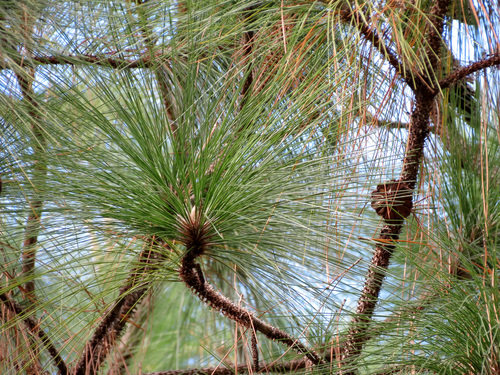
longleaf pine
Pinus palustris
The longleaf pine is the majestic architect of the Southern landscape, a fire-forged titan that supports one of the most biodiverse ecosystems in the world.
Quick Identification
Size
Reaches heights of 98–115 ft (30–35 m) and diameters of 28 in (0.7 m); historically up to 154 ft (47 m).
Colors
Lush dark green needles, silvery-white terminal buds, and reddish-brown scaly bark that matures to a plate-like texture.
Key Features
- Extraordinarily long needles (8–18 inches) in bundles of three
- Large woody cones 6–10 inches in length
- Prominent silvery-white terminal bud known as a 'candle'
- Thick, fire-resistant reddish-brown bark plates
When You’ll See Them
Behavior
The longleaf pine is a master of survival and a keystone species of the American South. Unlike many trees, it has a unique 'grass stage' during its first several years, where it looks like a clump of grass while focusing all its energy on developing a deep, resilient taproot. This stage allows it to survive the low-intensity ground fires that are essential to its ecosystem. Once the root system is established, it enters a 'rocket stage' of rapid vertical growth to quickly move its crown above the reach of flames.
As it matures, the longleaf pine creates an open, park-like savanna that supports a staggering level of biodiversity. It is a slow-growing but long-lived tree, capable of reaching ages of 300 to 500 years. Its relationship with humans is deep-rooted, having provided the 'naval stores' (pitch, resin, and timber) that fueled the early American economy, leading to its status as a cultural icon in states like Alabama and North Carolina.
EverydayEarth exclusive
Camera Tips
To capture the true essence of a longleaf pine on camera, you must focus on the tree as a hub for wildlife. Position your camera about 4–6 feet up the trunk facing downwards toward the base to capture Gopher Tortoises, which often burrow near the roots of these trees. If you are looking for the rare Red-cockaded Woodpecker, place your camera with a wide-angle lens focused on the upper third of the trunk, specifically targeting areas with visible sap flow or 'resin wells' where these birds create their cavities.
Lighting is crucial for longleaf pines. The best shots occur during the 'golden hour'—shortly after sunrise or before sunset—when the low-angle sun illuminates the long needles, giving them a glowing, translucent quality. During the spring, focus your camera on the terminal buds or 'candles.' These silvery-white tips are highly reflective, so you may need to adjust your exposure settings down to avoid 'blowing out' the whites in the image.
If you are using a trail camera for scouting, place it near a fallen longleaf cone. Large Sherman's Fox Squirrels are frequently attracted to these cones to forage for the large, nutritious seeds. Setting your camera to 'Burst Mode' or 'Photo + Video' is ideal here, as the squirrels often move quickly when dismantling the heavy cone scales. Ensure the camera is at least 10–15 feet away to accommodate the height of the tree if you want to capture its majestic silhouette.
Don't forget the seasonal changes. While evergreens don't lose their leaves, the longleaf pine sheds its older needles in the autumn, creating a thick 'pine straw' carpet. This is a great time to set cameras at ground level to capture ground-nesting birds or small mammals rustling through the needles. For settings, use a fast shutter speed (1/125 or higher) if you are trying to capture the swaying of the long needles in the wind, which can often cause motion-blur on cheaper sensors.
Similar Species
Species that look similar or are commonly confused with longleaf pine.
Frequently Asked Questions
Record longleaf pine at your habitat
Connect a camera to start building your own species record — AI identifies every visitor automatically.