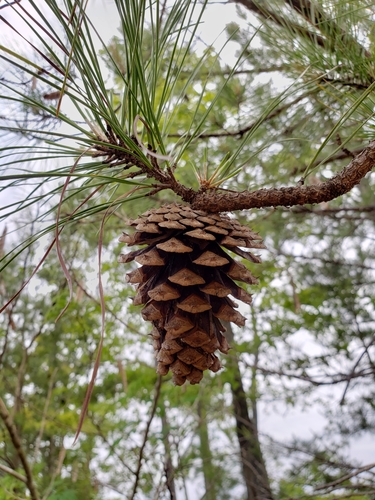
loblolly pine
Pinus taeda
The backbone of the American South, the loblolly pine is a fast-growing giant that turns your backyard into a bustling high-rise for birds and squirrels.
Quick Identification
Size
Typically reaches 30–35 meters (100–115 feet) in height with a trunk diameter of 0.4–1.5 meters (1.3–5 feet).
Colors
Dark yellowish-green needles; mature bark is a mix of dark gray and reddish-brown plates.
Key Features
- Needles in bundles of three (fascicles)
- Needles measure 6 to 9 inches long
- Ovoid cones with a sharp spine on each scale
- Deeply furrowed, rectangular bark plates on mature trunks
When You’ll See Them
Behavior
The loblolly pine is a powerhouse of the Southern forest, known for its remarkably fast growth and ability to colonize disturbed areas. Often called an "old-field pine," it is frequently the first tree to reclaim abandoned farmland or cleared lots. In a backyard setting, these trees act as the anchors of the local ecosystem, stretching their crowns high to dominate the canopy while providing a massive amount of vertical real estate for climbing and nesting creatures.
While they don't "behave" in the traditional sense, loblolly pines interact dynamically with their environment by shedding large amounts of needle litter, which creates a natural acidic mulch. They are also famous for their heavy spring pollen release, which can coat entire neighborhoods in a thin layer of yellow dust. For humans, they offer excellent shade and privacy, though their brittle limbs can be prone to breaking during heavy ice or wind storms.
EverydayEarth exclusive
Camera Tips
To capture the best of a loblolly pine, think of it as a vertical highway for wildlife rather than a stationary object. Use your AI camera to monitor the trunk at roughly 5 to 7 feet off the ground. This height is the 'sweet spot' for capturing the movement of Eastern Gray Squirrels, flying squirrels, and various species of woodpeckers, such as the Pileated or Red-bellied woodpecker, which frequently forage in the deep furrows of the bark for insects.
If you are looking to capture bird activity, aim your camera upward toward the lower horizontal branches where many songbirds find cover. The dense needle clusters provide excellent hiding spots for Cooper’s Hawks or owls during the day. For a truly unique shot, position your camera with a wide-angle lens near the base of the tree during late autumn. As the cones dry and open, they drop seeds that attract a flurry of ground-feeding birds and small rodents, creating a high-traffic zone for your camera to trigger.
Lighting is crucial when photographing trees. The reddish-brown plates of the bark really pop during the 'golden hour'—the hour after sunrise or before sunset. Set your camera’s white balance to 'Auto' but try to catch the side-lighting that emphasizes the deep textures of the bark. If your camera has a time-lapse feature, consider a long-term project spanning from March to April to capture the fascinating (if messy) process of the male catkins releasing clouds of yellow pollen.
Lastly, keep in mind that loblolly pines are resinous. If you mount your camera directly to the trunk, be careful of 'pine bleed.' Using a mounting strap rather than a screw-in mount will protect the tree and prevent sticky sap from getting onto your camera lens or housing. Check the lens periodically, as the fine pollen can create a haze on the glass during the spring months.
Similar Species
Species that look similar or are commonly confused with loblolly pine.
Longleaf Pine
Longleaf pines have much longer needles (up to 18 inches) and significantly larger, foot-long cones.
Shortleaf Pine
Shortleaf pines have much shorter needles (2-4 inches) and very small, egg-shaped cones without the painful prickles.
Slash Pine
Slash pines often have needles in bundles of both twos and threes, and their cones are glossy or 'varnished' in appearance.
Frequently Asked Questions
Record loblolly pine at your habitat
Connect a camera to start building your own species record — AI identifies every visitor automatically.