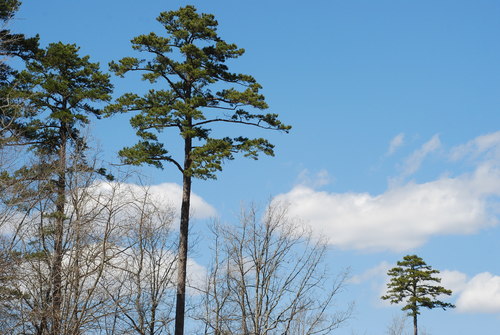
shortleaf pine
Pinus echinata
The shortleaf pine is the hardy architect of the American woodland, providing vital shelter and food for a vast array of backyard wildlife. With its distinctive resin-pitted bark and slender needles, it stands as a symbol of endurance and natural beauty.
Quick Identification
Size
Typically 20–30 meters (65–100 feet) tall with a trunk diameter of 0.5–0.9 meters (20–35 inches)
Colors
Dark bluish-green needles with reddish-brown bark that forms large, irregular plates
Key Features
- Needles in bundles of 2 or 3, measuring 3–5 inches long
- Small, egg-shaped cones (1.5–2.5 inches) with fine prickles
- Bark plates contain small, distinct 'resin pits'
- Straight, slender trunk with a high, rounded crown
When You’ll See Them
Behavior
The shortleaf pine is a remarkably resilient conifer known for its ability to thrive in poor, rocky soils where other trees struggle. Unlike many other pine species, young shortleaf pines have a unique ability to resprout from the base if the main stem is damaged by fire or browsing animals. This adaptation makes them a 'pioneer species,' often being among the first to reclaim open fields or disturbed areas.
Ecologically, these trees are a hub of activity. They grow at a moderate pace, eventually forming a tall, airy canopy that allows enough sunlight to reach the forest floor for grasses and wildflowers to grow. This creates a diverse ecosystem. For humans, they are prized for their high-quality timber, often called 'yellow pine,' which is used for everything from flooring to plywood.
EverydayEarth exclusive
Camera Tips
When using an AI camera like EverydayEarth to capture wildlife around a shortleaf pine, your focus should be on the trunk and the lower canopy. Many birds, such as the Brown-headed Nuthatch and various woodpeckers, frequent the thick, plate-like bark to hunt for insects hidden in the crevices. Mounting your camera roughly 5 to 8 feet up a neighboring tree, angled toward the pine’s trunk, is a great way to catch these 'bark-crawlers' in action.
If you are looking for squirrels or larger birds like Wild Turkeys and Blue Jays, place your camera near the base of the tree during the late fall and winter. This is when the small cones open and drop seeds, creating a natural foraging ground. Setting your camera to 'Burst Mode' or 'Photo + Video' is ideal here, as seed-eating behavior can be very fast-paced and twitchy.
For a unique perspective, try a time-lapse setting focused on the tips of the branches during the spring. You can capture the 'candles' (new growth shoots) elongating and the small, colorful male and female flowers appearing. Ensure your camera has a clear line of sight, as the fine needles can sometimes trigger motion sensors on windy days if the sensitivity is set too high.
Don't forget the 'Resin Pits.' If your camera has a good macro or close-up focus, aim it at a section of bark with visible small holes. These pits are often visited by specialized insects, and capturing the interplay between the tree's sap and the local bug life provides a fascinating look at the tree's defensive biology.
Similar Species
Species that look similar or are commonly confused with shortleaf pine.
Loblolly Pine
Loblolly has much longer needles (6-9 inches) and larger, more prickly cones compared to the shortleaf's petite features.
Longleaf Pine
Longleaf pines have massive needles up to 18 inches long and very large cones, making them much 'shaggier' than the shortleaf.
Virginia Pine
Virginia pine needles are almost always in bundles of two and are usually twisted, whereas shortleaf needles are straighter and often come in threes.
Frequently Asked Questions
Record shortleaf pine at your habitat
Connect a camera to start building your own species record — AI identifies every visitor automatically.