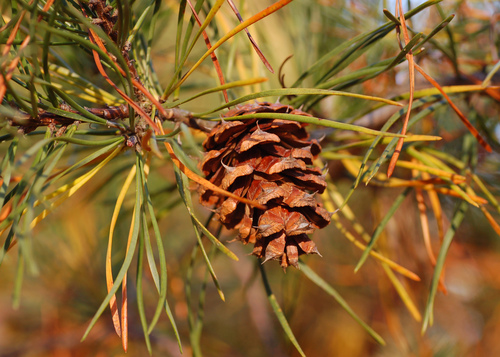
Virginia pine
Pinus virginiana
Often called the 'Scrub Pine,' the Virginia pine is a rugged survivor that provides essential year-round shelter for backyard birds and small mammals. Its twisted needles and prickly cones make it a distinctive and hardy staple of the Appalachian landscape.
Quick Identification
Size
Height of 18–60 feet (5.5–18 m); trunk diameter up to 20 inches (50 cm)
Colors
Yellow-green needles; gray-brown bark with reddish-brown scales; reddish-brown woody cones
Key Features
- Needles in bundles of two, typically twisted and 1.5–3 inches long
- Small, persistent cones with a sharp prickle on each scale
- Irregular, 'scrubby' branching pattern often reaching low to the ground
- Thin, scaly bark that forms small plates on mature trees
When You’ll See Them
Behavior
The Virginia pine is often called the 'scrub pine' due to its ability to thrive in poor, rocky, or exhausted soils where other trees struggle. As a pioneer species, it is one of the first to colonize abandoned fields or cleared land, acting as a natural stabilizer for the earth. Its growth habit is characteristically irregular, often developing a gnarled or 'stunted' aesthetic that provides a unique structural element to the landscape.
While it may not reach the towering heights of other pines, it plays a vital social role in the ecosystem. It provides dense, year-round cover for various wildlife, especially during harsh winters. Because it retains its lower branches longer than many other pine species, it offers excellent nesting sites and protection from predators for songbirds and small mammals.
EverydayEarth exclusive
Camera Tips
When using an AI-powered camera like the ones featured on EverydayEarth, the Virginia pine is an exceptional 'hub' tree. Because it often retains branches close to the ground, you should mount your camera at chest height (4-5 feet) on a nearby post or a different tree, aiming into the dense interior of the Virginia pine's canopy. The thick, twisted needles provide a natural, textured backdrop that makes colorful birds like Northern Cardinals or Blue Jays pop in your photos.
If you want to capture foraging behavior, place a suet feeder or a platform feeder within three feet of the Virginia pine’s branches. Small birds prefer these pines because they can dart in and out of the prickly foliage for safety. Set your camera to 'Burst Mode' or high-speed trigger settings, as the birds visiting these pines are often quick and jittery. Early morning light (6-9 AM) is ideal, as it filters through the needles without creating the harsh shadows that can confuse AI identification during the midday sun.
In the winter months, the Virginia pine becomes a focal point for activity. While other trees are bare, this pine remains green, making it a magnet for wildlife seeking thermal cover. Position your camera to face the south-side of the tree, which usually receives the most sun and activity during cold snaps. If you are mounting the camera directly to the trunk, use a bark-safe strap and check it every few months, as the scaly bark of a Virginia pine can flake off, potentially shifting your camera's alignment.
Similar Species
Species that look similar or are commonly confused with Virginia pine.
Loblolly Pine
Has much longer needles (6-9 inches) usually in bundles of three, rather than two.
Shortleaf Pine
Features longer needles (3-5 inches) and bark with distinct resin pockets not found on Virginia pine.
Pitch Pine
Has needles in bundles of three and is known for having 'epicormic' sprouts (tufts of needles) growing directly out of the trunk bark.
Frequently Asked Questions
Record Virginia pine at your habitat
Connect a camera to start building your own species record — AI identifies every visitor automatically.