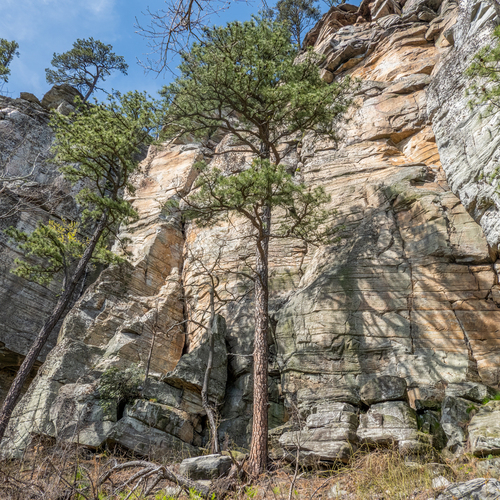
pitch pine
Pinus rigida
The rugged architect of the American pine barrens, the pitch pine is a fire-defying evergreen known for its gnarled beauty. With needles that sprout directly from its trunk, it stands as a testament to resilience in the harshest soils.
Quick Identification
Size
A medium-sized tree reaching 6–30 m (20–100 ft) in height with a trunk diameter of 0.3–0.9 m (1–3 ft).
Colors
Deep yellowish-green needles; bark is thick, reddish-brown, and broken into irregular, plate-like scales; cones are light brown and prickly.
Key Features
- Needles in bundles of three, 2-5 inches long
- Thick, craggy bark with deep furrows
- Epicormic branching (tufts of needles growing directly from the trunk)
- Broadly egg-shaped cones with a sharp prickle on each scale
- Irregular, often twisted or gnarled branch structure
When You’ll See Them
Behavior
The pitch pine is the ultimate survivor of the eastern North American forest. Unlike most conifers that perish in intense heat, the pitch pine has evolved a remarkable relationship with fire. Its exceptionally thick bark acts as a heat shield, and it possesses dormant buds beneath the bark that allow it to sprout new needles directly from its trunk and thick limbs after a fire—a phenomenon known as epicormic sprouting.
Ecologically, these trees are the backbone of 'pine barren' ecosystems. They provide a year-round evergreen canopy that offers vital thermal cover for white-tailed deer and roosting sites for raptors. Because they often grow in nutrient-poor, sandy soils, they grow slowly and develop a rugged, weather-beaten appearance that makes every individual tree look like a natural bonsai sculpture.
EverydayEarth exclusive
Camera Tips
When setting up a trail camera to feature a pitch pine, position your device about 4 to 5 feet off the ground, facing the trunk. This height is perfect for capturing the tree's most unique identifier: the 'trunk sprouts.' These small tufts of green needles emerging directly from the thick, plate-like bark create a striking visual texture that distinguishes the pitch pine from any other pine in your backyard or local woods.
Use the 'Time Lapse' setting on your camera to capture the tree through the seasons. Because pitch pines are evergreen, they provide the only splash of color in a dormant winter forest. A photo every morning at 10:00 AM can create a stunning sequence showing how the tree holds heavy snow on its stiff needles compared to the more flexible branches of a White Pine. The cones are also highly reactive to weather; they open in dry heat and close during damp periods, which can be captured over several days of footage.
If you are looking to capture wildlife using the tree, aim your camera at a low-hanging limb or the base of the trunk. Pitch pine seeds are a high-energy food source for red squirrels and crossbills. By placing your camera near a cluster of cones, you are likely to trigger captures of foraging birds and small mammals. During the summer, the deep furrows in the bark often host various insects, which in turn attract nuthatches and woodpeckers that you can catch spiraling up the trunk.
Lighting is key for this species. Try to angle your camera so the morning or evening sun hits the bark at a side-angle (oblique lighting). This will emphasize the deep furrows and ridges of the reddish-brown bark, making for a much more professional and dramatic 'hero shot' of the tree. Avoid placing the camera facing directly into the sun, as the dense needles can cause high-contrast 'hot spots' in your images.
Similar Species
Species that look similar or are commonly confused with pitch pine.
Eastern White Pine
White pines have 5 needles per bundle and much longer, thinner, resinous cones without prickles.
Red Pine
Red pines have needles in bundles of two that snap cleanly when bent; pitch pine needles are in threes and are more flexible.
Loblolly Pine
Loblolly pines have much longer needles (6-9 inches) and are typically found further south than the pitch pine's core range.
Frequently Asked Questions
Record pitch pine at your habitat
Connect a camera to start building your own species record — AI identifies every visitor automatically.