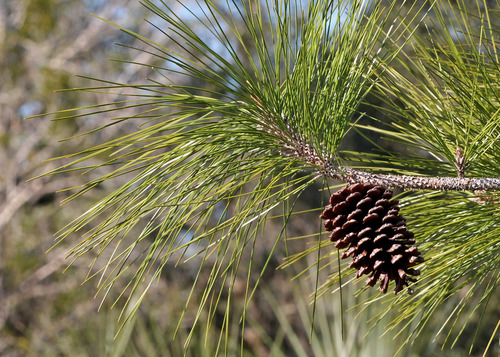
slash pine
Pinus elliottii
The sentinel of the South, the slash pine is a towering beauty that thrives where other trees fear to tread. With its glossy cones and dual-needle bundles, it provides the ultimate high-rise habitat for the Southeast's most iconic wildlife.
Quick Identification
Size
Height of 18–30 meters (60–100 feet); trunk diameter of 0.6–0.8 meters (2–2.6 feet)
Colors
Deep green needles; bark is purplish-gray with reddish-brown interior plates; cones are glossy caramel-brown
Key Features
- Needles occur in bundles of both 2 and 3 on the same branch
- Cones are glossy and egg-shaped, 2.5 to 6 inches long
- Bark forms large, flat, papery scales
- High, rounded crown with spreading branches
When You’ll See Them
Behavior
In a backyard or forest setting, the slash pine is a social hub for wildlife. Its high canopy provides a sturdy platform for large raptors to build nests, while its thick bark offers countless crevices for insects to hide, which in turn attracts insectivorous birds. Though it remains stationary, the tree is a dynamic participant in the landscape, releasing massive clouds of yellow pollen in the late winter and shedding its heavy, glossy cones in the fall.
EverydayEarth exclusive
Camera Tips
When using a trail camera with a slash pine, your strategy should be two-fold: using the tree as a secure mounting post and capturing the unique wildlife that visits its canopy. For mounting, the slash pine’s thick, plated bark provides excellent grip for strap-based mounts. Place your camera at a height of 3–5 feet, but use a wedge to tilt it slightly downward if you are targeting ground-dwelling critters like gopher tortoises or wild turkeys that frequent the sandy soil near these trees.
To capture the tree's own beauty or the birds that visit it, position a secondary camera 10–15 feet away, facing the trunk. If you are lucky enough to have a slash pine with low-hanging branches, aim your camera toward the clusters of needles. During the morning 'golden hour,' the sun hitting the long, dark green needles creates a shimmering effect that can trigger motion sensors on high-sensitivity settings. This is a great way to photograph Brown-headed Nuthatches or Pine Warblers foraging for insects along the bark.
If you are interested in time-lapse photography, the slash pine is an ideal subject in early spring. Set your camera to take a photo every 4–6 hours to document the 'candles'—the bright green new growth—as they elongate rapidly. For wildlife baiting near the tree, scattering a few handfuls of sunflower seeds at the base of the trunk will draw out squirrels and birds from the high canopy into your camera’s field of view. Ensure your shutter speed is set high (at least 1/60) to account for the swaying of the needles in the coastal breeze.
Similar Species
Species that look similar or are commonly confused with slash pine.
Longleaf Pine
Has much longer needles (up to 18 inches) always in bundles of 3, and much larger, non-glossy cones.
Loblolly Pine
Needles are usually in bundles of 3 (rarely 2) and are shorter and more yellowish-green than the slash pine.
Shortleaf Pine
Has significantly shorter needles (2-4 inches) and much smaller, egg-shaped cones.
Frequently Asked Questions
Record slash pine at your habitat
Connect a camera to start building your own species record — AI identifies every visitor automatically.