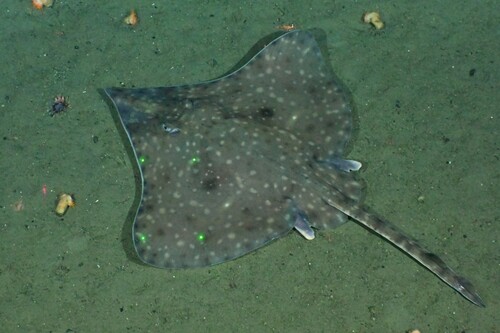
Longnose Skate
Caliraja rhina
The Longnose Skate is a master of the Pacific seafloor, easily recognized by its unusually sharp, elongated snout and beautiful 'eyespots' that mimic the gaze of a much larger predator.
Quick Identification
Size
Up to 1.4 m (4.6 ft) in length; can weigh up to 15 kg (33 lbs)
Colors
Dorsal surface is brownish-grey to reddish-brown; featuring two large, dark ocelli (eyespots) with pale borders; underside is typically muddy white or bluish-grey
Key Features
- Distinctly elongated and sharply pointed snout
- Two large dark eyespots on the pectoral fins
- Deeply notched pelvic fins
- Slender tail with small spines and two dorsal fins near the tip
When You’ll See Them
Geographic range
Where Does the Longnose Skate Live?
The Longnose Skate is native to the temperate and cold waters of the Northeast Pacific Ocean. Its range extends from the eastern Bering Sea and southeastern Alaska southward along the coasts of Canada and the United States to Baja California and the Gulf of California. While they are found across a wide latitudinal range, they are most concentrated along the continental shelf of the Pacific Northwest.
Basemap © OpenStreetMap contributors
Behavior
The Longnose Skate is a graceful bottom-dweller that spends much of its life patrolling the seafloor or lying partially buried in the sand. Using its broad, wing-like pectoral fins, it glides effortlessly over the substrate, occasionally using a technique called 'punting' where it uses its pelvic fins to push off the bottom. Unlike many other marine species, they are generally solitary and non-territorial, moving between different depths depending on the season and food availability.
These skates are oviparous, meaning they lay eggs rather than giving birth to live young. They produce large, leathery egg cases known as 'mermaid's purses,' which they anchor to the seafloor. While they are wary of larger predators like sharks and sea lions, they are relatively docile and show little aggression toward humans, often remaining perfectly still when approached by divers in the hopes that their camouflage will keep them hidden.
EverydayEarth exclusive
Camera Tips
Capturing a Longnose Skate on an AI-powered camera requires a specialized underwater setup, typically a Baited Remote Underwater Video (BRUV) system or a stationary camera mounted to a pier or dock piling. To get the best results, position your camera 30-60 cm (1-2 feet) above a sandy or muddy seafloor, angling it slightly downward. This orientation allows you to clearly see the skate's unique pointed snout and the 'eyespots' on its wings as it glides through the frame.
Since these fish rely heavily on their sense of smell, using a bait box is the most effective way to draw them into your camera's field of view. Fill a mesh bag or perforated container with oily fish like sardines, chopped squid, or crushed crab. Place the bait about 1 to 2 meters in front of the lens. The scent will travel with the current, and you can often watch the skate 'track' the scent upstream until it reaches your camera station.
Lighting is crucial for deep-water or nighttime captures. Use infrared (IR) illuminators or dimmable red LED lights to avoid startling the animal, as bright white light can cause them to flush or swim away quickly. If your camera supports it, set the AI to trigger on 'large marine life' or movement, but ensure the sensitivity is adjusted so that drifting kelp doesn't fill your storage with empty clips. In shallower 'backyard' coastal areas, winter and spring often provide the clearest water visibility for the best image quality.
Similar Species
Species that look similar or are commonly confused with Longnose Skate.
Big Skate
Much larger than the Longnose Skate with a blunter snout and more circular ocelli.
Sandpaper Skate
Lacks the prominent eyespots of the Longnose Skate and has a much rougher, tooth-like skin texture.
California Skate
Has a shorter snout and more varied spotting across the wings rather than two distinct large ocelli.
Frequently Asked Questions
Record Longnose Skate at your habitat
Connect a camera to start building your own species record — AI identifies every visitor automatically.