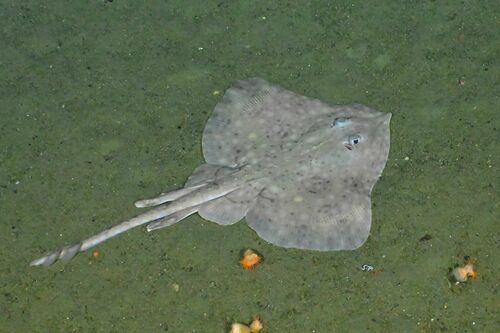
Sandpaper Skate
Bathyraja kincaidii
The Sandpaper Skate is a hidden gem of the Pacific floor, a graceful cartilaginous fish with a texture as rugged as its name suggests. Witness the elegant 'flight' of this deep-sea resident as it glides through the dark waters of the continental shelf.
Quick Identification
Size
Total length of 35-63 cm (14-25 inches); weight typically ranges from 0.5-2 kg (1.1-4.4 lbs)
Colors
Dorsal side is uniform muddy brown, grayish, or tan with occasional small dark spots; ventral (underside) is pale cream or white
Key Features
- Extremely rough, sandpaper-like texture on the upper surface
- Single continuous row of 15-21 sharp thorns along the tail
- Rounded snout and pectoral fins that resemble wings
When You’ll See Them
Behavior
The Sandpaper Skate is a master of the seafloor, spending much of its life gliding just inches above the muddy or sandy bottom of the Pacific Ocean. Unlike many of its more aggressive relatives, this species is relatively sedentary, often seen resting on the substrate or partially burying itself in sediment to avoid detection. They move with a graceful, undulating motion of their large pectoral fins, a style of swimming often compared to flight.
Socially, Sandpaper Skates are solitary hunters. They do not form schools and generally only interact with others of their species during the breeding season. They are oviparous, meaning they lay eggs in tough, leathery protective cases known as 'mermaid's purses.' These cases are often found washed up on beaches after the young have hatched, serving as a sign of their presence in nearby deep waters.
EverydayEarth exclusive
Camera Tips
Capturing the Sandpaper Skate requires a specialized marine setup, as they reside in the deep 'backyards' of coastal Pacific residents. If you are using a dock-mounted underwater camera or a drop-cam, focus your efforts on areas with soft, silty, or sandy bottoms. These skates avoid rocky reefs where their soft undersides could be damaged. Positioning your camera within 12-24 inches of the seabed, angled slightly downward, is the most effective way to catch them as they cruise for food.
Because they are most active in low-light or near-total darkness, high-quality infrared (IR) or red-light illumination is essential. Standard white light can be harsh and often startles these sensitive creatures, causing them to bolt before you get a clear image. A camera with a wide-angle lens is preferred, as it captures the full span of their 'wings' as they glide past the frame.
To attract a Sandpaper Skate to your lens, use a scent-based lure rather than visual bait. A perforated PVC tube or mesh bag filled with oily fish like sardines or mackerel will release a scent trail that these skates can detect from a distance using their sensitive electroreceptors and sense of smell. Secure the bait directly in front of the camera's focal point to ensure they linger long enough for the AI to trigger an identification.
Be patient with your deployments. These skates are not high-energy swimmers; they may take several hours to follow a scent trail. Check your footage for 'sand clouds'—a telltale sign that a skate has recently settled into the mud or taken off near your camera. In deeper coastal waters, late summer and autumn are often the most productive times for sightings as they move into slightly shallower ranges for breeding.
Similar Species
Species that look similar or are commonly confused with Sandpaper Skate.
Big Skate
Much larger (up to 8 feet) and features two prominent dark spots on its wings that look like eyes.
Longnose Skate
Easily distinguished by its very long, pointed snout and more angular wing shape.
Starry Skate
Has a more mottled pattern and a different arrangement of thorns on its back and tail.
Frequently Asked Questions
Record Sandpaper Skate at your habitat
Connect a camera to start building your own species record — AI identifies every visitor automatically.