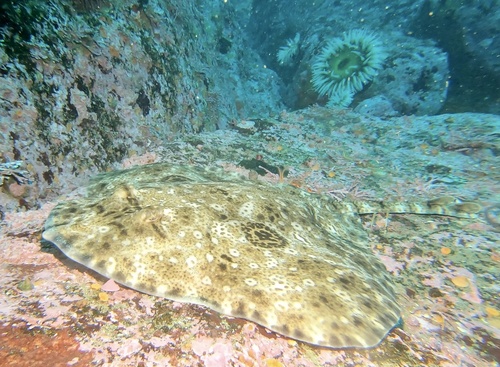
Starry Skate
Caliraja stellulata
A celestial wonder of the deep Pacific, the Starry Skate is named for the stunning constellation of sharp, star-shaped prickles that adorn its back. This elusive relative of the shark haunts the rocky reefs of the West Coast, blending perfectly into the shadows of the seafloor.
Quick Identification
Size
Maximum length of 71-76 cm (28-30 inches); hatchlings are approximately 15-22 cm (6-9 inches)
Colors
Dorsal side is grayish-brown to olive with numerous small dark spots and larger, star-like pale spots; underside is typically white or cream.
Key Features
- Densely covered in small, sharp prickles or 'stars'
- Distinctive diamond-shaped pectoral fins
- Rows of enlarged thorns along the mid-line of the back and tail
- Small dark ocelli or 'eye spots' often visible on the wings
When You’ll See Them
Behavior
The Starry Skate is a patient, bottom-dwelling predator that spends much of its time gliding just above or resting upon rocky seafloors. Unlike their more social ray cousins, these skates are primarily solitary, using their camouflaged dorsal side to blend into the complex textures of the Pacific reef systems. They are masters of low-energy hunting, often settling into the sediment to ambush unsuspecting prey that wanders too close to their 'wings.'
While they are generally docile and pose no threat to humans, they are well-protected by a formidable array of sharp dermal denticles and thorns that give them a sandpaper-like texture. In the wild, they are known to be relatively sedentary, occupying a specific depth range where the water remains cold and nutrient-rich. Their movement is characterized by a graceful undulating motion of their pectoral fins, a method of swimming that allows them to hover precisely over uneven terrain.
EverydayEarth exclusive
Camera Tips
Capturing the Starry Skate requires a specialized approach since they reside in deep marine environments rather than terrestrial backyards. To see one, you will need a submersible 'drop camera' or a Baited Remote Underwater Video (BRUV) system. Mount your camera within a weighted, corrosion-resistant frame and lower it near rocky reef edges or transition zones where rocky bottom meets sand. These are the primary corridors where skates forage for crustaceans.
Because the Starry Skate lives at depths where sunlight is filtered or absent, artificial lighting is essential. However, many marine species are startled by bright white light. Use high-powered red LEDs if possible, as many deep-sea organisms cannot perceive red light, allowing you to observe their natural behavior without scaring them away. Ensure your camera is angled slightly downward to capture the skate's intricate dorsal patterns, which are its most identifying feature.
Bait is the most effective way to draw a Starry Skate into the frame. Use a mesh bait bag filled with oily fish like mackerel, squid, or crushed crab. Secure the bait bag about 1-2 meters in front of the lens. The scent trail will travel with the current, drawing the skate in from down-current. Be patient; these fish move slowly and may take thirty minutes or more to follow a scent trail back to its source.
For camera settings, prioritize a high frame rate (60fps) even in low light to capture the fluid movement of their wings. If your camera allows for it, set a long recording trigger or use a time-lapse mode that takes a photo every 10 seconds. In the cold, high-pressure environments where Starry Skates thrive, battery life will deplete faster than normal, so use external battery packs or high-capacity lithium-ion cells rated for cold temperatures.
Similar Species
Species that look similar or are commonly confused with Starry Skate.
Frequently Asked Questions
Record Starry Skate at your habitat
Connect a camera to start building your own species record — AI identifies every visitor automatically.