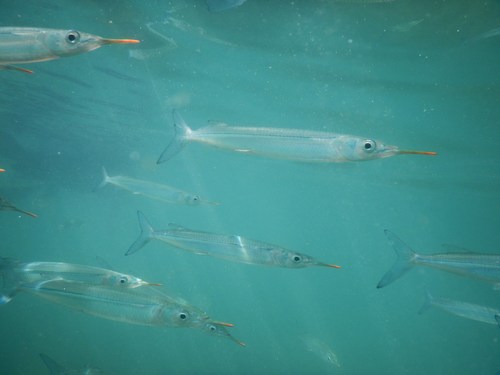
Longtail Garfish
Hyporhamphus quoyi
A sleek, surface-skimming marvel of the Indo-Pacific, the Longtail Garfish is famous for its unique 'halfbeak' and its ability to skip across the waves to evade predators.
Quick Identification
Size
Typically 20-30 cm (8-12 inches) in length, reaching a maximum of 40 cm (16 inches)
Colors
Silvery-white underside and flanks with a prominent silvery lateral stripe; the dorsal (top) surface is a translucent greenish-blue or olive. The tip of the lower jaw is often marked with a bright orange or reddish tint.
Key Features
- Extremely elongated lower jaw with a short, triangular upper jaw
- Slender, streamlined silvery body
- Large scales that detach easily
- Forked caudal fin with the lower lobe longer than the upper
When You’ll See Them
Geographic range
Where Does the Longtail Garfish Live?
Native to the Indo-West Pacific, the Longtail Garfish occupies a massive geographic footprint. Its range begins in the warm waters of the Red Sea and East Africa, stretching eastward across the Indian Ocean to the tropical coastlines of Southeast Asia and the Philippines. In the Western Pacific, they are commonly found from the southern islands of Japan down through the Indonesian archipelago to the northern half of Australia, particularly within the sheltered reefs and mangroves of the Great Barrier Reef.
Basemap © OpenStreetMap contributors
Behavior
The Longtail Garfish, also known as Quoy's Halfbeak, is a surface-dwelling specialist that spends most of its life in the top few centimeters of the water column. They are highly social and are typically found in small to medium-sized schools, which provide protection from predators. When threatened by larger predatory fish or diving birds, they exhibit a remarkable 'skipping' behavior, launching themselves out of the water and vibrating their tails to taxi across the surface at high speeds.
In coastal and backyard dock environments, they are relatively bold but easily spooked by sudden shadows. They are most frequently observed hovering near structures like pier pilings, mangrove roots, or over seagrass beds where the water is calm. While they are not aggressive toward humans, they are curious and will often investigate floating objects or slow-moving ripples on the water's surface.
EverydayEarth exclusive
Camera Tips
Capturing the Longtail Garfish requires a specialized approach since they reside almost exclusively at the air-water interface. For those with a backyard dock or seawall, the best results come from mounting an action camera (in an underwater housing) just 2-5 inches below the surface, angled slightly upward. This captures the unique silhouette of their elongated lower jaw against the light of the sky. If you are using a trail camera from above the water, use a circular polarizing filter over the lens to cut through the surface glare, which otherwise obscures the fish.
To draw a school into your camera's field of view, use floating bait. Small bits of bread or floating fish pellets are highly effective as they stay in the 'strike zone' of the garfish's upward-pointing mouth. Because these fish are sensitive to movement, avoid mounting cameras on floating docks that bob significantly; a fixed piling or a weighted tripod placed in shallow water during low tide will provide much more stable footage.
The best time for filming is mid-morning when the sun is high enough to illuminate the water but not directly overhead, which creates harsh shadows. If you are filming in an estuary or mangrove area, aim to set your camera during the incoming tide. The influx of clear ocean water improves visibility significantly compared to the murky water often seen on an outgoing tide. Set your camera to a high frame rate (60fps or higher) if possible, as their movements and 'skips' are incredibly fast and look best in slow motion.
Similar Species
Species that look similar or are commonly confused with Longtail Garfish.
Frequently Asked Questions
Record Longtail Garfish at your habitat
Connect a camera to start building your own species record — AI identifies every visitor automatically.