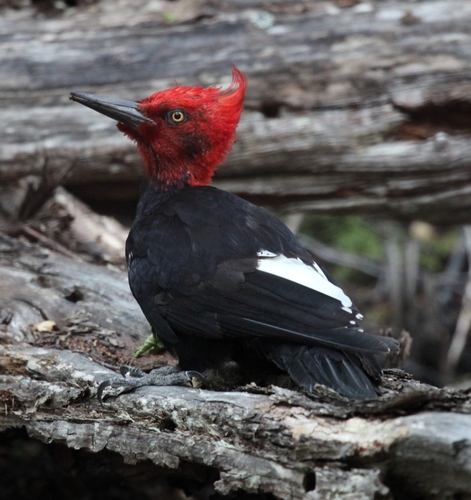
Magellanic Woodpecker
Campephilus magellanicus
The undisputed king of the Patagonian forests, the Magellanic Woodpecker is a prehistoric-looking giant known for its thundering double-knock and flaming red crest.
Quick Identification
Size
Length 36-45 cm (14-18 in); Wingspan 66-75 cm (26-30 in); Weight 300-360 g (10.6-12.7 oz)
Colors
Males have a completely bright crimson-red head and crest with black bodies. Females are almost entirely black with a small red patch at the base of the bill and a distinctive curled crest.
Key Features
- Vibrant crimson-red head on males
- Long, forward-curling black crest on females
- Loud, echoing 'double-tap' drum
- Large white wing patches visible during flight
When You’ll See Them
Geographic range
Where Does the Magellanic Woodpecker Live?
This spectacular woodpecker is native to the southern tip of South America, making it the southernmost member of its genus. It is found exclusively in the temperate rainforests and subantarctic woodlands of southern Chile and southwestern Argentina. From the Araucanía Region down to the rugged islands of Tierra del Fuego, this bird remains a year-round resident of the pristine Patagonian wilderness.
Basemap © OpenStreetMap contributors
Behavior
The Magellanic Woodpecker is a highly social and intelligent bird, often found in family groups consisting of a breeding pair and their offspring from previous years. Unlike many other woodpecker species that are solitary, these birds maintain close contact through soft conversational chirps and their iconic 'double knock'—two rapid, powerful strikes against a tree that can be heard for over a kilometer through the forest.
They are remarkably bold and curious around humans, often continuing their foraging activities while being observed at a distance. When moving, they use a methodical hitching motion to climb vertical trunks, using their stiff tail feathers as a tripod. Their presence is often announced not by their call, but by the heavy sound of bark being stripped away as they search for food in the ancient trees of the Patagonia region.
EverydayEarth exclusive
Camera Tips
To successfully capture a Magellanic Woodpecker on your AI camera, you must identify 'active' trees within your vicinity. Look for large, old-growth trees (especially Southern Beech) that show signs of fresh excavation—bright wood chips at the base of the trunk are a surefire sign of recent activity. Mount your camera at a height of 5 to 8 feet on an adjacent tree, angling it slightly upward toward a known foraging hole or a horizontal branch where they might land before climbing.
These birds are particularly attracted to decaying wood. If you have a large backyard or woodlot, leaving standing dead trees (snags) is the best way to keep them coming back to the same spot. You can also try placing a suet feeder near the trunk of a large tree, though they much prefer natural larvae. Because they are large birds, ensure your camera is positioned far enough back (about 10-15 feet) to capture their entire body and their impressive crest without cropping.
Settings are crucial for this species. Their drumming and head-flicking motions are extremely fast, so use the highest shutter speed or 'Sports' mode available on your camera to avoid motion blur. Since they are social, set your camera to record video clips of at least 20 seconds; this allows you to capture the fascinating social interactions and the sound of their unique double-tap drumming, which is as much a visual treat as it is an auditory one.
Similar Species
Species that look similar or are commonly confused with Magellanic Woodpecker.
Frequently Asked Questions
Record Magellanic Woodpecker at your habitat
Connect a camera to start building your own species record — AI identifies every visitor automatically.